A Home for Tea: Japan’s Tea Caddies, From the Shogun’s Jars to Bark and Copper
On a kitchen shelf in almost every Japanese home sits a tea caddy — a chazutsu. You lift the lid, scoop out the leaves, close it again. It is about as ordinary as an object can be. Yet behind it lies a story centuries long: how Japan gave its tea a home.
That story runs from great sealed jars carried along the highways for the shogun, to the everyday green tea of ordinary households, to tinplate shipped from Britain in the age of Japan’s opening to the West. And across the country, each region answered the same question with its own materials — cherry bark, hammered copper, tin. Remarkably, every one of these caddies slowly changes in the hands of the person who uses it.
The shogun’s tea jars — when tea travelled
In the Edo period, the first tea of the year from Uji, near Kyoto, was sealed in large jars and carried to the shogun in Edo. This “tea-jar procession,” ochatsubo dōchū, began in 1633 and continued until the end of the shogunate — some 235 journeys in all. At times the procession numbered over a thousand people and outranked even the grand processions of feudal lords.
The new tea spent the summer in a cool natural cave in Kai Province and was opened only in November, at the start of the tea-ceremony hearth season. The children’s song Zui zui zukkorobashi is said to describe villagers shutting themselves indoors as the procession passed. Tea, back then, was that precious.
Green tea comes home
In 1738, Nagatani Sōen of Uji succeeded in making fine sencha, and over time leaf tea spread from the privileged few into ordinary homes. Tea leaves needed protection from damp and light, and a container that could be opened and closed for every cup. In place of the great jar, each household kitchen needed a small home for its tea.
Tinplate from across the sea
In the Meiji era, tinplate arrived from Britain and round metal canisters began to be made in Japan. At the same time, Japanese tea became a national export: from the Meiji to the Taishō era, 10,000 to 20,000 tonnes a year left the country, most of it bound for the United States. Western materials wrapped Japanese tea, and Japanese tea travelled west — the tea caddy stood right at that crossroads.
Each region’s answer
Kyoto — Kaikado’s metal caddies. Founded in 1875, in the thick of Japan’s westernisation, Kaikado was a pioneer in making round canisters from British tinplate. Its caddies go through more than 130 steps, and the lid sinks shut silently under its own weight. Kaikado is said to have buried its tools in the ground to keep making caddies when metal was requisitioned during the war, and for 150 years it has kept almost exactly the same form. Why did it win hearts around the world? It began with overseas travellers in Kyoto carefully buying caddies to take home; then, in 2006, Kaikado demonstrated its craft at a London tea shop, where a round caddy assembled before customers’ eyes won over a nation that buys its tea in square tins. Airtightness, a timeless design and a life of a hundred years with repairs — those qualities led to a place in the permanent collection of London’s Victoria and Albert Museum, and today Kaikado caddies hold coffee beans as well as tea in kitchens across the world.
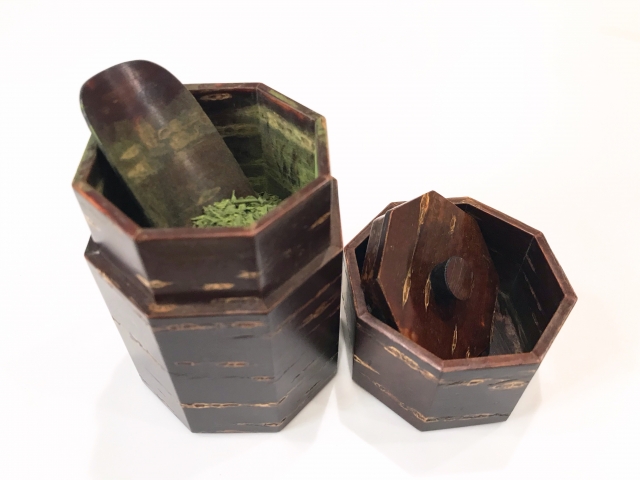
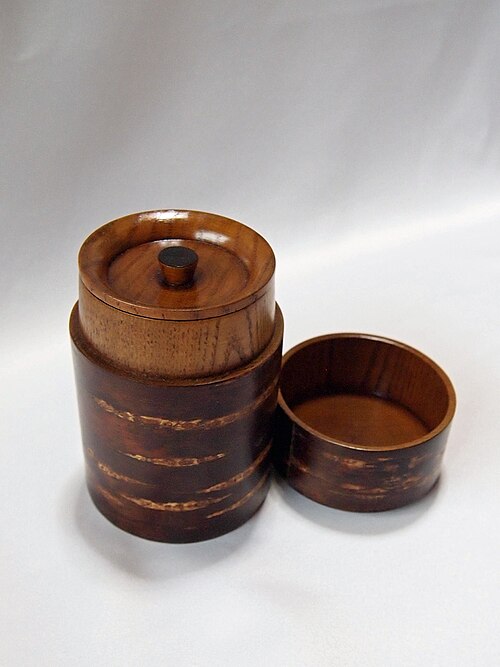
Kakunodate, Akita — cherry bark, kabazaiku. In Kakunodate, a town of preserved samurai houses, tea caddies are clad in the bark of mountain cherry trees. The technique arrived from northern Akita in the 1780s and was passed down as side work for lower-ranking samurai; after the Meiji Restoration, it became a new livelihood for former samurai families. Tea caddies, made by wrapping bark around a wooden form, are its signature pieces, and in 1976 kabazaiku became Akita’s first nationally designated traditional craft. Cherry bark is said to resist damp and bacteria, and it gains lustre the more it is used.
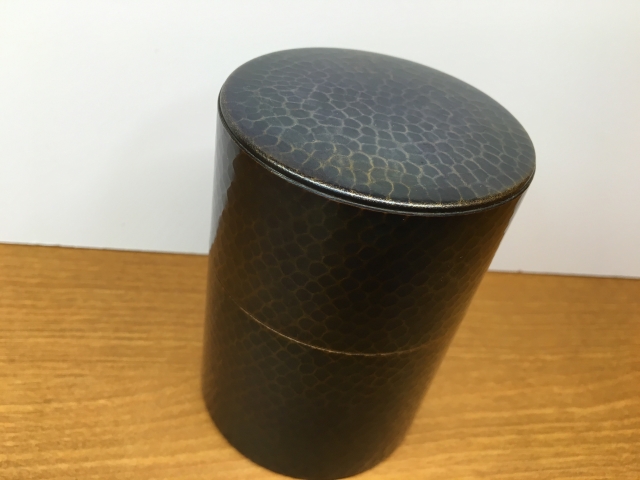
Tsubame, Niigata — copper hammered from a single sheet. In Tsubame, a town of metalworkers, Gyokusendo, founded in 1816, practises tsuiki — raising a vessel from a single copper sheet with hammer blows. Around 200 kinds of hammer are used; the copper hardens as it is struck, so it is softened in the fire and struck again, over and over. Kettles, sake vessels and tea caddies are all made this way, one at a time. The workshop exhibited at the 1873 Vienna World’s Fair. Copper deepens with use — a kettle used for fifty years takes on a richness no new piece can match.
Osaka — turned tin, Osaka Naniwa suzuki. Early Edo-period records already mention tinware made and sold in Osaka, and the craft traces back to a tin shop that opened in Shinsaibashi in the late Edo period. At its peak in the 1920s and 30s, Osaka had over 300 tin craftsmen; the war halved their number, and only a handful of tinware makers remain today. It was designated a traditional craft in 1983. A tin caddy depends on the craftsman’s skill on the lathe to fit lid and mouth exactly; its weight in the hand and soft silver colour are its charm.
What they share: they grow
Different materials, different towns — yet these caddies share one thing. They change in the hands of the person who uses them.
| Material | How it ages |
|---|---|
| Copper (Kyoto, Tsubame) | From a bright reddish shine to a glossy deep amber. Kaikado says change begins in 2–3 weeks |
| Brass (Kyoto) | From vivid gold to a soft, muted gold; about a month |
| Tinplate (Kyoto) | From clear silver to a gentle sheen, slowly, over 6 months to a year |
| Cherry bark (Kakunodate) | Gains lustre the more it is used |
Like Hagi ware’s “seven changes” and lacquer that “grows,” a tea caddy is finished by the days of the person who uses it.
A journey through tea-caddy towns
Visiting the towns where caddies are made shows you why they came to be. Check opening hours before you go.
| Town | Where | What to do |
|---|---|---|
| Kakunodate, Akita | Kakunodate Kabazaiku Denshokan | Stroll the samurai district, then see 200-year-old masterpieces and live demonstrations. The shop is free to enter. 9:00–16:30 (until 16:00 Dec–Mar); closed 28 Dec–4 Jan. Admission ¥500 |
| Tsubame, Niigata | Gyokusendo main store | Tour the workshop without booking during opening hours and hear the ring of hammer on copper; the main house is a registered Tangible Cultural Property. Weekdays 8:30–17:30 |
| Kyoto | Kaikado main store and Kaikado Café | Feel the lid glide shut at the store, then take tea in a 1927 tramway depot turned café. Store 9:00–18:00 (closed Sun, Mon, holidays); café 10:00–18:30 (closed Thu) |
Where to buy in Tokyo, Osaka, Nagoya and Fukuoka
| City | Where | Notes |
|---|---|---|
| Tokyo | Gyokusendo Ginza (GINZA SIX, 4F) | Hammered-copper tea caddies from Tsubame, in central Tokyo |
| Tokyo | CIBONE (Aoyama and CASE stores) | Kaikado stockist |
| Tokyo, Osaka, Nagoya, Fukuoka | Department stores | Kaikado stockists: Mitsukoshi Nihonbashi and Matsuya Ginza (Tokyo), Hankyu Umeda and Takashimaya Osaka, Takashimaya (Nagoya), Hakata Hankyu and Iwataya (Fukuoka). Japanese tableware floors may also carry tin or cherry-bark caddies |
Stock varies by store and season, so call ahead to check.
Getting it home: A tea caddy won’t break, but a dent can spoil how the lid closes. Keep it in its box, and if you’re flying, put it in your carry-on bag rather than checked luggage.
Bringing a caddy home online — how to choose well
| Site | Notes |
|---|---|
| Ippodo Tea (English store) | A Kaikado copper caddy with the Ippodo seal; check delivery to your country |
| Yoshien (Germany) | A European tea retailer stocking Kaikado caddies |
| Kaikado online shop | Direct from the workshop, but ships within Japan only and declines orders via forwarding services |
How to choose well
- By material: copper to see change soon, cherry bark for the warmth of wood, tin for a satisfying weight
- By size: match the amount of tea you usually keep (for example 100g or 200g)
- By maker and origin: the workshop, the region, or a Traditional Craft label should be clearly stated
Caring for your caddy
- Stroke a metal caddy gently with your palm every day so the colour develops evenly
- Don’t handle it with wet hands. Skip washing with water and wipe with a dry cloth (copper can show a harmless blue-green patina, rokushō, if it gets wet)
- Keep cherry-bark caddies away from water and direct sun, and wipe with a soft dry cloth
- Take care not to drop it
A home for tea, and for your own time
From the shogun’s jars travelling the highways to a small caddy on a kitchen shelf, the home of Japanese tea has changed shape with the times, made from each region’s materials and skills: Kakunodate’s cherry bark, the ring of Tsubame’s hammers, Osaka’s tin, Kyoto’s tinplate. The caddy you find on your travels will touch your hand with every morning cup, and slowly change colour. Perhaps the newest page of this centuries-old story is written in your own kitchen.
Read next: More things that grow with you → Hagi Ware: The Pottery That Slowly Takes On Your Life / Jōbōji-nuri: A Cup of Lacquer From a Single Tree, and Bowls That Glow With Time