Glover Garden: Steam Trains, Docks and Beer — Thomas Glover, the Man Who Sold the Future in Open-Port Nagasaki
The Man Who Watched the Sea from a House on the Hill
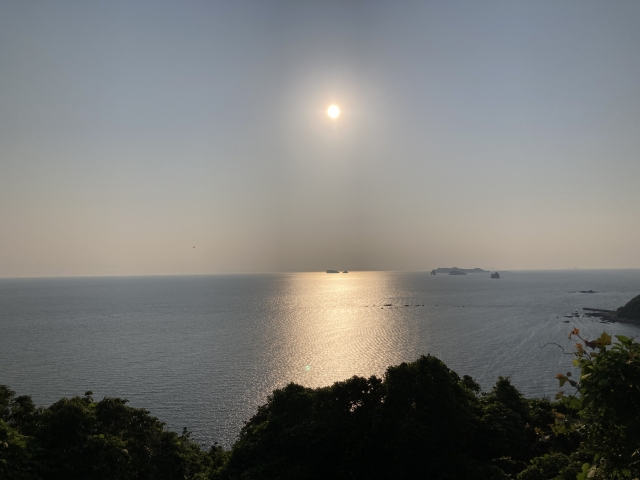
At the top of a cobbled slope, the view suddenly opens. Below lies Nagasaki Harbor. Shipyard cranes move slowly, and beyond them the ridgeline of Mount Inasa rises in layers.
No one knows that view better than the house standing at the top of the slope: the Former Glover House. Completed in 1863, it is the oldest surviving Western-style wooden building in Japan. Its owner was a young merchant from Scotland, Thomas Blake Glover.
Before I visited, Glover House was, to me, “a building that preserves the look of a Western house from the last years of the shogunate.” I thought of it as a place to enjoy exotic architecture and a harbor view. But as I walked through the exhibits inside, my interest drifted from the building itself to the man who lived there. Who, I wondered, was the master of this house?
Glover’s name tends to come with one label: “the arms dealer who knew Sakamoto Ryoma.” Follow his life, though, and that label turns out to be only a small part of it. Tea, railways, shipbuilding, coal mining, and beer. He started venture after venture in a foreign land, and even after going bankrupt, he stayed. Glover, too, was a courageous entrepreneur.
Background: A Newly Opened Port in a Japan on the Edge of Change
For most of the Edo period (1603–1868), the shogunate limited foreign trade to a few narrow channels, a policy known as sakoku, the “closed country.” Nagasaki, through the tiny artificial island of Dejima, was Japan’s only window to the West.
In 1859, Nagasaki opened as a free-trade port, alongside Yokohama and Hakodate. Foreign settlements were laid out on the hills of Minamiyamate and Higashiyamate overlooking the harbor, and merchants from many countries crossed the sea to gather there.
It was far from safe. A storm of anti-foreign sentiment, under the slogan sonno joi, “revere the emperor, expel the barbarians,” swept the country, and tension deepened between the shogunate and powerful domains such as Satsuma and Choshu. Simply living in the settlement could cost a foreigner his life.
Yet the greatest opportunities lie at the heart of the greatest change. Believing exactly that, a young man stepped ashore in Nagasaki the very year the port opened.
Who Was Thomas Glover? A Scot Who Crossed the Sea at 21
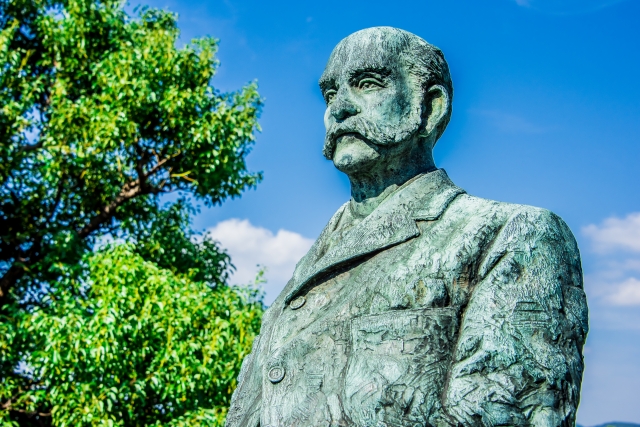
Thomas Blake Glover was born in 1838 in Fraserburgh, a harbor town in northeast Scotland.
In 1859, he traveled via Shanghai to the newly opened port of Nagasaki. He was just 21. He worked on business connected with Jardine Matheson, the British trading house that was a major power in Asia, and before long founded his own firm, Glover & Co.
The company began by exporting tea and raw silk, and soon moved into selling ships and weapons to the powerful domains of southwestern Japan. By the mid-1860s, it was the largest foreign trading house in Nagasaki.
In 1870, early in the Meiji era, the firm ran out of cash and went bankrupt. Even so, Glover did not leave Japan. He went on to help manage the Takashima coal mine, served as an adviser to Mitsubishi, supporting Iwasaki Yataro and his successors, and played a part in founding a brewing company.
In 1897, he moved to Tokyo with his Japanese wife, Tsuru. In 1908, he became the first foreigner to receive the Order of the Rising Sun, Second Class. He died at his home in Tokyo in 1911, at the age of 73. He had spent more than half his life in Japan.
Glover, an Entrepreneur of Japan’s Opening Years
Lay out Glover’s work side by side, and you see less a single merchant than a founder launching one new venture after another. Here are five reasons why.
1. He jumped into a dangerous market before anyone else
In an era when foreigners were sometimes attacked, a 21-year-old crossed to Nagasaki the very year it opened. That alone was a big bet. Entering a market before anyone knew how to win in it: today we would call him a first mover.
2. He read the times and chose his partners
Glover saw that the southwestern domains, such as Satsuma and Choshu, would soon move history, and he sold them ships and weapons. He went further, helping young men who defied the national ban on travel to study in Britain. Among them were the “Choshu Five,” including Ito Hirobumi and Inoue Kaoru, and Satsuma students such as Godai Tomoatsu and Mori Arinori.
These young men later became central figures in Meiji Japan. Glover was not only selling goods; he was investing in trust with the country’s future leaders.
3. He created a market by showing, not telling
In 1865, Glover shipped the steam locomotive Iron Duke, bought in Shanghai, to Nagasaki and ran it on tracks laid along the Oura waterfront. This was a full seven years before Japan’s first railway opened between Shimbashi and Yokohama.
A mass of iron, breathing smoke as it rolled. Seeing it, people grasped the power of steam in an instant. Show the real thing rather than explain it: he understood the power of a demonstration.
4. He built industries beyond trade
Many ships sold in Nagasaki at the time were secondhand and constantly breaking down. Glover planned a large repair yard with Godai Tomoatsu and Komatsu Tatewaki of Satsuma. With machinery brought from Scotland, the Kosuge Slip Dock was completed in 1868. Because the cradle that carried ships looked like an abacus, it was nicknamed the “Soroban (Abacus) Dock.”
Around the same time, foreseeing rising demand for coal, he began developing a modern mine on Takashima Island, outside Nagasaki Harbor, with British machinery and engineers. Both the dock and the mine later passed to Mitsubishi and became foundations of Japan’s shipbuilding and energy industries. Today both are part of the UNESCO World Heritage Site “Sites of Japan’s Meiji Industrial Revolution.”
5. He went bankrupt, and rose again
Large investments like these demanded enormous capital. On top of that, the huge stock of weapons and ships he had bought in anticipation of civil conflict went unsold once the new government took power. Unable to collect payment on credit sales to the domains, Glover & Co. went bankrupt in 1870.
Most people would have gone home at that point. Glover stayed. He helped run the Takashima mine and served Mitsubishi as an adviser across three generations of its leaders, Iwasaki Yataro, Yanosuke and Hisaya. He also played an important role when the Japan Brewery Company was founded in Yokohama, the company that would become Kirin Brewery. The whiskers on the mythical kirin on its label are even said to be modeled on Glover’s moustache.
Bet big, fail big. Yet instead of stopping there, he moved on to the next stage, armed with the relationships and knowledge he had built. That tenacity, I think, is where Glover’s true gift as an entrepreneur lies.
After Zeniya Gohei, the wave of opening arrived
Zeniya Gohei, the great merchant of Kaga, died in prison in 1852. The following year, Commodore Perry’s “black ships” appeared at Uraga. And in 1859, the year Nagasaki opened, Glover arrived.
Gohei, who saw opportunity beyond the closed sea, died just before the door opened. Within only a few years, that door was pushed open from the outside, and foreign merchants came one after another. There was no direct connection between the two men. Still, when I set their lives side by side, I could feel how suddenly, and how powerfully, the wave of opening was pressing in on Japan.
→ Read next: Zeniya Gohei Memorial Museum: The Edo-Era Entrepreneur Who Built a Fortune on the Sea
Highlights of Glover Garden
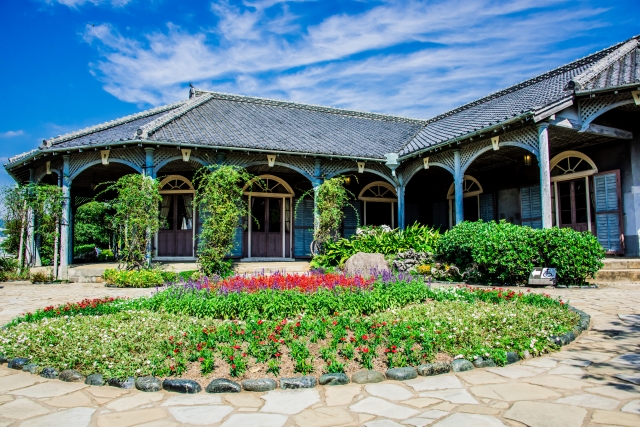
Glover Garden is an open-air museum that opened in 1974 around the Former Glover House. Western houses from the foreign settlement era are scattered across a slope overlooking the harbor. Allow one to two hours.
The Former Glover House: Japan’s oldest Western-style wooden building
Completed in 1863, it is the oldest surviving Western-style wooden building in Japan. It is a National Important Cultural Property and part of the UNESCO World Heritage Site “Sites of Japan’s Meiji Industrial Revolution.” Seen from above, its roof is shaped like a four-leaf clover, and Japanese roof tiles sit alongside Western chimneys. After conservation work, it reopened to the public in 2021.
Stand on the veranda, and Nagasaki Harbor spreads out below. Perhaps he watched ships come in from here and pictured his next deal. He also met with samurai from Satsuma and Tosa in this house to talk business.
The Former Ringer House and other settlement-era homes
The garden holds nine historic buildings, including the Former Glover House. One is the home of Frederick Ringer, who worked for Glover & Co. before founding his own firm. Each building offers a glimpse of how the merchants of the settlement lived.
Note that the Former Alt House and the Former Jiyutei restaurant are currently closed to visitors for conservation work. Check the official website for the latest status.
Ride the Glover Sky Road and walk downhill
From near the Ishibashi tram stop, an inclined elevator called the Glover Sky Road, followed by a vertical elevator, takes you to Gate 2 at the top of the garden, free of charge. Entering at the top and walking down makes the visit much easier on your legs.
Free guided tours and Lantern Night
History guides lead free tours of the garden. In 2026, Glover Garden Lantern Night runs from October 12 to December 31, when lanterns and illuminations light up the Western houses at dusk.
What a Man Who Made His Life Abroad Leaves Us
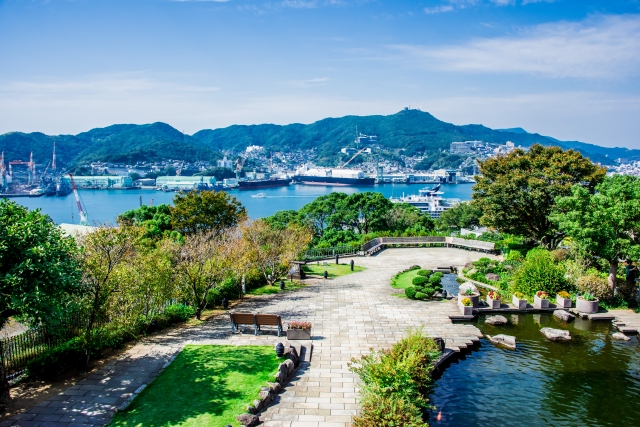
Looking out at the harbor from the veranda of the Former Glover House, I found myself wondering: at 21, in a country whose language and culture were utterly different from his own, what did he hold on to?
To leave Scotland and head for the far side of the world must have been, for a young man of 21, a decision on which he staked his whole life. Even so, he crossed the sea, and in this country he discovered where his own value lay: in connecting Western technology with the new Japan that was about to be born. Building trust with the young men he sent to Britain, his partners from Satsuma, and the people of Mitsubishi, he put down deep roots here. That, I believe, is why he never left, even after bankruptcy cost him so much.
“If I fail, it’s all over.” If that fear is holding you back, this house on the hill is the place to visit. The story of a man who lost nearly everything and still made his life in this country quietly reminds us that the road goes on, even beyond a challenge.
Practical Information and Access
Glover Garden is open every day of the year from 8:00 a.m. Admission fees changed on April 1, 2026, so be careful with older information.
| Address | 8-1 Minamiyamate-machi, Nagasaki, Nagasaki Prefecture |
| Hours | Usually 8:00–18:00 (last entry 20 minutes before closing); 8:00–20:00 from November 1 to December 31, 2026 |
| Closed | Open every day |
| Admission | Adults ¥1,300; elementary, junior high and high school students ¥650; preschool children free. Annual pass: adults ¥3,250 |
| Phone | +81-95-822-8223 |
| Parking | None on site (use nearby parking lots) |
By tram: From Nagasaki Station, take a tram and transfer at Shinchi Chinatown to a tram bound for Ishibashi. Get off at Oura Tenshudo for a walk of about 7 minutes. Or get off at Ishibashi and take the Glover Sky Road up to Gate 2 at the top of the garden. Note that Gate 2 does not accept credit cards.
By car: About 10 minutes from Nagasaki IC on the Nagasaki Expressway. There is no dedicated parking.
Please check the official website (in Japanese) for the latest hours and building access before you go.
Nearby
- Oura Cathedral: A National Treasure church just below Glover Garden. A combined ticket with Glover Garden is available.
- Kosuge Slip Dock Site: The remains of Glover’s “Abacus Dock,” part of the World Heritage Site. The surrounding area is free to visit, and it is the place to feel Glover the entrepreneur at work.
In Closing: Meeting Another Entrepreneur on the Hill
Glover Garden is more than exotic Western houses and a harbor view. It is where the story of an entrepreneur who helped move Japan into the modern age still lingers.
- A first mover who arrived the year the port opened
- An investment in trust with the leaders of the future
- A demonstration that showed the future with a steam locomotive
- Industrial foundations laid with a dock and a coal mine
- A comeback after bankruptcy
Climb the cobbled slope and look out at the harbor from the veranda. The presence of a young man who pictured the future in this same view, more than 160 years ago, will leave a long, quiet resonance.