A 30-Year Life That Moved an Era: Shoin Jinja and Shoka Sonjuku in Hagi
Cross the Matsumoto River from Hagi’s old castle town and head east. In a quiet residential neighbourhood stands Shoin Jinja, the shrine dedicated to Yoshida Shoin.
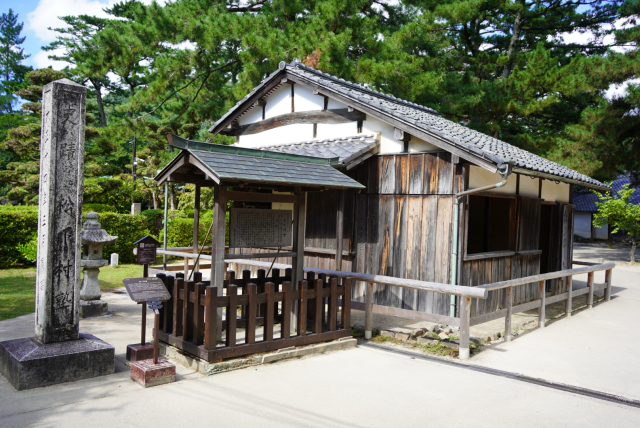
In one corner of its grounds is a small, single-storey building with a tiled roof: Shoka Sonjuku. From this modest schoolhouse came Takasugi Shinsaku, Kusaka Genzui, Ito Hirobumi, Yamagata Aritomo and other young men who would change the course of Japanese history.
What astonishes visitors is how briefly Shoin taught here, and how young he was: he died at just 30. How could one man leave such a mark in so little time?
Yoshida Shoin: A Prodigy’s 30-Year Life
Yoshida Shoin was born in 1830 into a low-ranking samurai family in Hagi. From early childhood he studied military science under the strict guidance of his uncle, Tamaki Bunnoshin, and his talent was obvious from the start.
He is said to have lectured at Meirinkan, the domain school, at just nine years old, and at eleven to have expounded a military classic before the domain lord, Mori Takachika. Picture a boy explaining strategy to a room of grown samurai, and you begin to sense how extraordinary he was.
As a young man, Shoin travelled to Kyushu, Edo and the northeast to learn, studying under scholars such as Sakuma Shozan. In 1854, when Commodore Perry’s fleet returned to Japan, he tried to stow away on one of the American ships to study abroad. The attempt failed; he turned himself in and was sent back to Hagi and imprisoned in Noyama Prison. Even there, it is said, he lectured his fellow prisoners.
In 1859, caught up in the shogunate’s crackdown known as the Ansei Purge, Shoin was taken to Edo and executed on 27 October. He was 30 years old by the traditional Japanese count. Ryukonroku, the testament he wrote for his students on the eve of his death, opens with this poem:
Though my body may decay on the plains of Musashi, I would leave my Yamato spirit behind.
Though his body might rot in a distant field, his resolve would remain in this world. That wish was fulfilled through the young men he taught.
An Unconventional Man
Trace Shoin’s life and a strikingly unconventional character emerges.
- Deep absorption: In roughly 14 months in Noyama Prison, he is said to have read more than 600 books.
- Loyalty over rules: At 22, he had promised friends a departure date for a journey to northeastern Japan, but his domain’s travel permit did not arrive in time. Believing it shameful to break his word, he left without it. He was treated as a deserter and stripped of his samurai status and stipend.
- Acting on conviction: On seeing Perry’s fleet, he rowed out in a small boat and asked in person to be taken abroad.
- Candour without calculation: At his final interrogation, he is said to have volunteered details of a plot against a senior shogunate official that the authorities did not yet know about.
Yet he was also deeply human. In prison, he asked fellow inmates skilled in calligraphy and haiku to teach him, creating a place where everyone taught everyone. He believed it better to trust too much than to doubt, and he never stopped believing in other people’s strengths. His Edo expense book even records that he bought daifuku sweets six times in one month, with a note that he was ashamed of it. It is hard to square with the image of a stern revolutionary: a man who simply could not resist something sweet. When I learned of it, I found Shoin utterly charming.
Single-minded, sometimes awkward enough to clash with those around him, yet more trusting than anyone and never too proud to learn from others, whatever their status. Perhaps it was precisely this combination that drew such a varied group of young people to him.
Shoka Sonjuku: A Short Time, an Immeasurable Impact
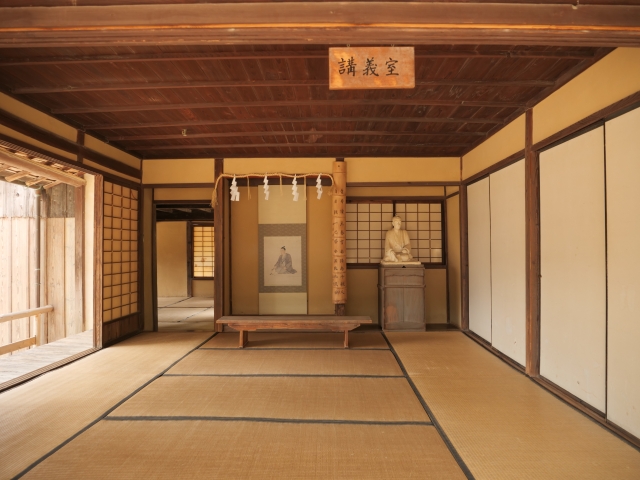
Shoka Sonjuku was originally a private school opened in 1842 by Shoin’s uncle, Tamaki Bunnoshin. After his release from prison, Shoin was confined to his family home, and there he began teaching local young people. In 1857, a storage shed was converted into an eight-mat schoolroom, and as students multiplied, a ten-and-a-half-mat room was added the following year. That small building still stands in the shrine grounds.
📷 Photo idea: the eight-mat lecture room seen from the veranda
Barely Two Years of Teaching
Shoin taught from 1856 until the end of 1858, when he was sent back to Noyama Prison. That is a little over two years in total, and only about a year as head of the school in its own building. He was still in his late twenties.
In that brief time, this tiny school produced a remarkable number of the people who would bring about the Meiji Restoration and build modern Japan: Takasugi Shinsaku and Kusaka Genzui, who died in the turmoil of the 1860s, and Ito Hirobumi and Yamagata Aritomo, who both went on to become prime minister.
Why Was His Influence So Great?
- A school open to all: While Meirinkan admitted only the sons of higher-ranking samurai, Shoka Sonjuku welcomed young people regardless of rank or age. Ito Hirobumi, born into a farming family and later adopted into a foot-soldier household, was one of them.
- Attention to each student: Shoin is said to have spoken politely even to boys of humble birth, finding and praising each one’s strengths. The school was less a place of instruction than one where teacher and students learned and debated together.
- Lighting a fire of purpose: Shoin’s idea of somo kukki, that people of conviction should rise up whatever their status, went beyond passing on knowledge. He kept asking his students what they would do for their country, and that question moved them to act.
- Living what he taught: From his attempt to board Perry’s ship to his death in the Ansei Purge, Shoin lived by his own convictions. Because his words and his life matched, his teaching left a deep mark on his students.
The Young Men of Shoka Sonjuku
The young people who came to Shoka Sonjuku differed widely in rank and age. There were sons of high-ranking samurai, of doctors, of foot soldiers, and a young man born into a farming family. Students who would never have shared a desk at the domain school sat together in those two small rooms, arguing over the same questions.
- Takasugi Shinsaku (high-ranking samurai family): Heir to a distinguished house and a student at Meirinkan. Knowing how competitive he was, Shoin is said to have praised his fellow student Kusaka to spur him on. Takasugi later founded the Kiheitai, a militia that recruited men regardless of class. He died of illness at 29, before he could see the Meiji era.
- Kusaka Genzui (domain physician’s family): One of Shoin’s most highly regarded students, who married Shoin’s younger sister Fumi. Shoin said that if Takasugi’s insight and Kusaka’s talent were combined, nothing would be beyond them. Kusaka took his own life during the Kinmon Incident at just 25.
- Ito Hirobumi (born into a farming family): He joined at 17. Shoin’s verdict was blunt, noting that his talent and learning were still immature, but he also recognised “a gift for bringing people together”. Ito became Japan’s first prime minister.
- Yamagata Aritomo (below foot-soldier rank): Introduced by Kusaka. Even after becoming prime minister, he signed himself “Shoin’s disciple Aritomo” and revered Shoin as his teacher all his life.
- Irie Kuichi (foot-soldier family): He became head of his household after his father’s death and studied while working. He could attend the school for only about a month, yet Shoin praised his intelligence and depth of purpose. He died at 28 in the Kinmon Incident.
- Yoshida Toshimaro (foot-soldier family): Counted with Takasugi, Kusaka and Irie among the “Four Heavenly Kings” of Shoin’s school. He died at just 24 in the Ikedaya Incident of summer 1864. At the Ikedaya, an inn in Kyoto, some twenty pro-imperial activists from Choshu and other domains had gathered to plan an uprising, when the Shinsengumi, a sword-wielding police force serving the shogunate, stormed the building. Many of the activists were killed or captured. Outrage over the raid drove Choshu to send troops to Kyoto the following month, leading to the Kinmon Incident in which Kusaka and Irie also lost their lives.
Shoin did not rank his students against one another; he saw each one’s differences as strengths. Many of them died young, their goals unfinished, while those who survived went on to build a new nation. Picture each of those faces in that small room, and Shoka Sonjuku begins to look like what we might now call a place that turned diversity into strength.
In an age when birth fixed a person’s place in society, Shoin chose to look past the class system altogether. As I understand it, he believed that what makes a nation strong is not rank but each person’s abilities and individual character. It seems no coincidence that his student Takasugi later built the Kiheitai, a militia that recruited men regardless of class.
Why These Names Matter: From a Small Room to a Modern Nation
For readers less familiar with Japanese history, it helps to know what these young men went on to do.
For more than 250 years, Japan was ruled by the Tokugawa shogunate, a military government headed by samurai, with society divided into fixed classes and contact with the outside world tightly restricted. In 1868, an alliance led by the Choshu and Satsuma domains overthrew the shogunate and restored power to the emperor. This turning point, the Meiji Restoration, launched Japan’s rapid transformation into a modern industrial state. Within a few decades, the country had a constitution, a parliament, railways, modern schools and a national army. Many of the people who drove that change came from Choshu, and several of them had sat in Shoin’s tiny classroom.
- The Kiheitai: Founded by Takasugi Shinsaku in 1863, the Kiheitai (literally “irregular militia”) was revolutionary in a society where only samurai were supposed to bear arms. It recruited farmers, merchants and samurai side by side, trained them in Western-style tactics, and judged them by ability rather than birth. In 1866 Choshu’s forces, with the Kiheitai among them, repelled a shogunate invasion, a defeat that badly weakened the shogunate on the road to the Restoration.
- Ito Hirobumi: The farmer’s son Shoin described as having “a gift for bringing people together” became Japan’s first prime minister in 1885 and served four times in all. He led the drafting of the Meiji Constitution of 1889, Japan’s first modern constitution, which established its parliament.
- Yamagata Aritomo: The young man from below foot-soldier rank built the foundations of Japan’s modern army, introducing nationwide conscription in 1873, and served twice as prime minister.
In other words, the ideas debated in two small rooms in Hagi in the late 1850s fed directly into the making of modern Japan.
In 2015, Shoka Sonjuku was inscribed as part of the UNESCO Sites of Japan’s Meiji Industrial Revolution. Peer into the lecture room from the veranda, and you can almost picture the young men crowded into that narrow space, debating late into the night.
The Shrine and Its Grounds
Shoin Jinja began in 1890, when a small earthen-walled shrine was built beside Shoka Sonjuku to honour Shoin’s spirit, enshrining items such as the inkstone he loved. In 1907, at the request of former students including Ito Hirobumi, it was officially recognised as a shrine. Half a century after their teacher’s death, and long after the Restoration they had achieved, his students had not forgotten him.
Today it is also loved as a shrine of learning, and many come to pray for success in exams.
I have also heard that many Japanese business leaders, drawn to the spirit of the young men of the 1860s, make a point of visiting the shrine. Perhaps they see, in the resolve that opened up a new era, something of what they hope for their own work and organisations.
Visit in person and you may be surprised by how modest the shrine grounds are, for a shrine honouring a man who helped move Japan from the shogunate into the Meiji era. To me, though, that smallness felt like a quiet message: what matters is not the size of the place, but the size of one’s aspirations.
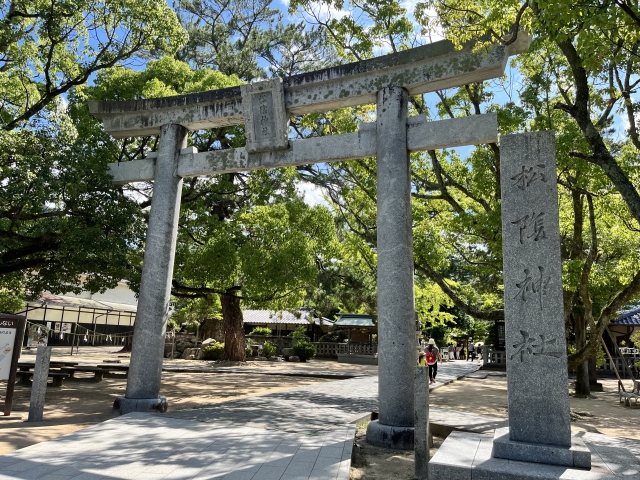
The stone torii of Shoin Jinja, bearing the shrine’s name plaque, with the approach running on beneath fresh spring greenery.
Shoka Sonjuku
The first place to visit is Shoka Sonjuku itself. From outside the veranda, you can see the eight-mat lecture room and the ten-and-a-half-mat room added later. Portraits of Shoin and of the students who went on to make their names hang in the lecture room.
Shoin’s Former Residence
This is the former home of the Sugi family, where Shoin lived in confinement after leaving prison. The three-and-a-half-mat room where he was confined survives as it was. The ideas that moved the young men of Shoka Sonjuku took shape in this tiny space.
Shiseikan Treasure Hall
Opened in 2009, the treasure hall has a free area introducing Shoin’s life and the places in Hagi connected to him, and a paid gallery displaying his calligraphy and personal belongings. Seeing his handwriting up close makes him feel strikingly human.
Yoshida Shoin History Museum
This museum recreates Shoin’s life in 20 scenes with more than 70 life-size wax figures, from his attempt to board Perry’s ship to his lectures at Shoka Sonjuku. It is an easy way to follow the story of his life.
Essentials
- Name: Shoin Jinja (Shoin Shrine)
- Address: 1537 Chinto, Hagi, Yamaguchi Prefecture
- Visiting: The shrine grounds and Shoka Sonjuku are free to visit
- Shiseikan Treasure Hall: 9:00–17:00 (last entry 16:30), open every day. Paid gallery ¥500 for adults
- Yoshida Shoin History Museum: Separate admission
- Access: About 12 minutes from JR Higashi-Hagi Station on the Hagi Maaru loop bus (eastbound), getting off at “Shoin Jinja-mae”
- Parking: Free, 64 spaces
Fees and hours are subject to change. Please check the shrine’s official website for the latest information.
Closing Thoughts
A life of just 30 years, and barely two of them spent teaching. Yet Yoshida Shoin’s resolve lived on in the young men of Shoka Sonjuku, and in time it reshaped Japan.
In the last years of the Edo period, Perry’s arrival was bringing Japan’s long era of national seclusion to an end, and the very foundations of society were shifting. Amid that upheaval, Shoin kept asking himself how his generation would carve out its own future, and he made his students ask it too. He did not hand them answers; he made them think. It seems to me that his question still reaches us today, as we live through great change of our own.
Stand on the veranda and look into that small eight-mat room. What shapes people and moves an era is neither the length of time nor the size of the place, but the size of one’s aspirations. This small, quiet corner of Hagi makes that clear.