
Wine from the Sand: An Early-Summer Stay at Cave d’Occi Winery, Niigata
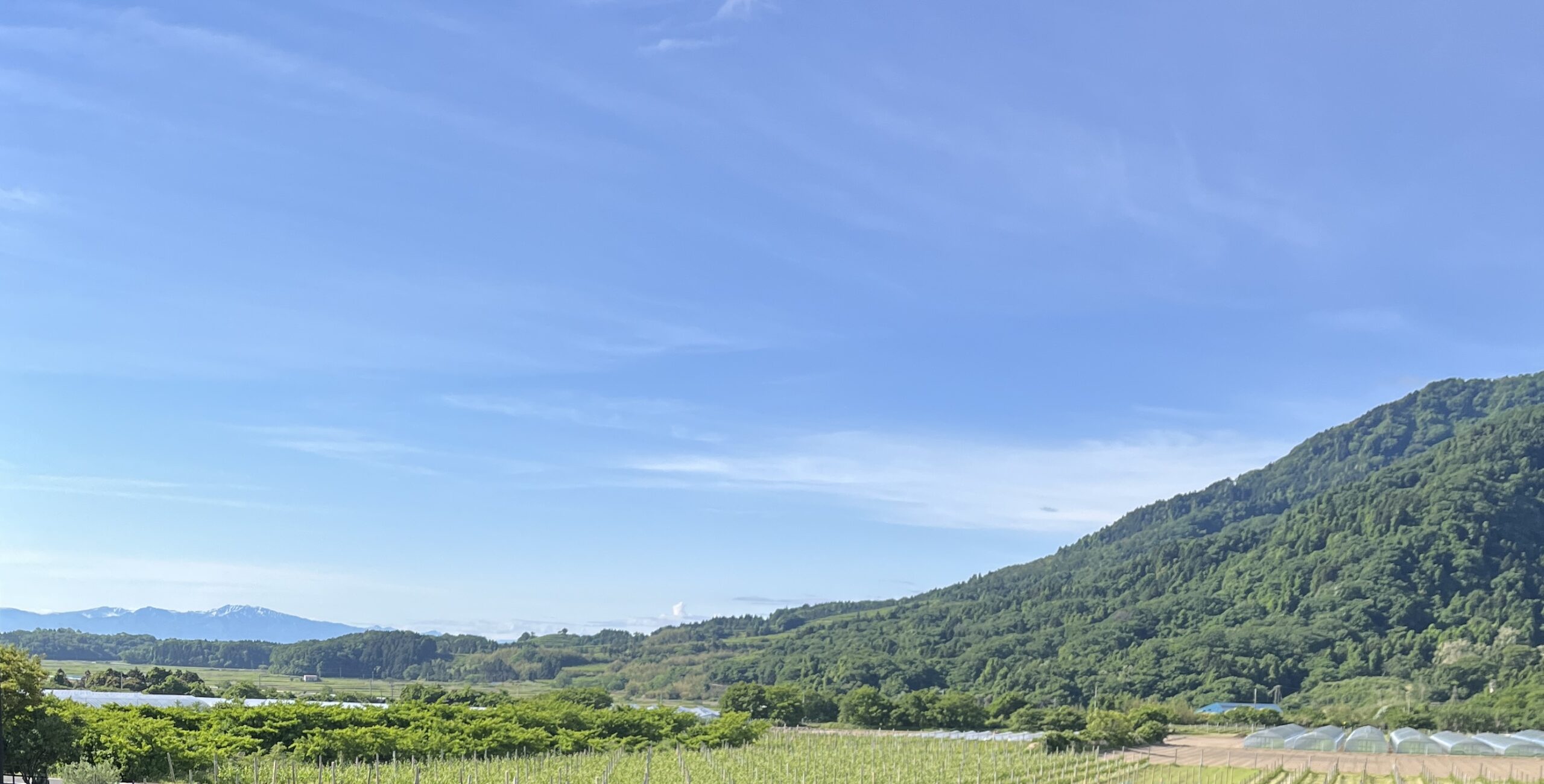
From Niigata Station, a local train and then a bus carry you towards the Sea of Japan. Before long, neat rows of vines appear in front of the gentle ridge of Mount Kakuda.
This is Cave d’Occi (カーブドッチ). On sandy ground close enough to the sea to walk there, a winery, a small hotel, restaurants, shops and hot springs have grown into what the Japanese call a taizai suru wainarī, a winery you stay at.
I have stayed here twice, once at the end of May and once in early June. Both times it was just before the rainy season, when the air is still dry and the breeze is soft.
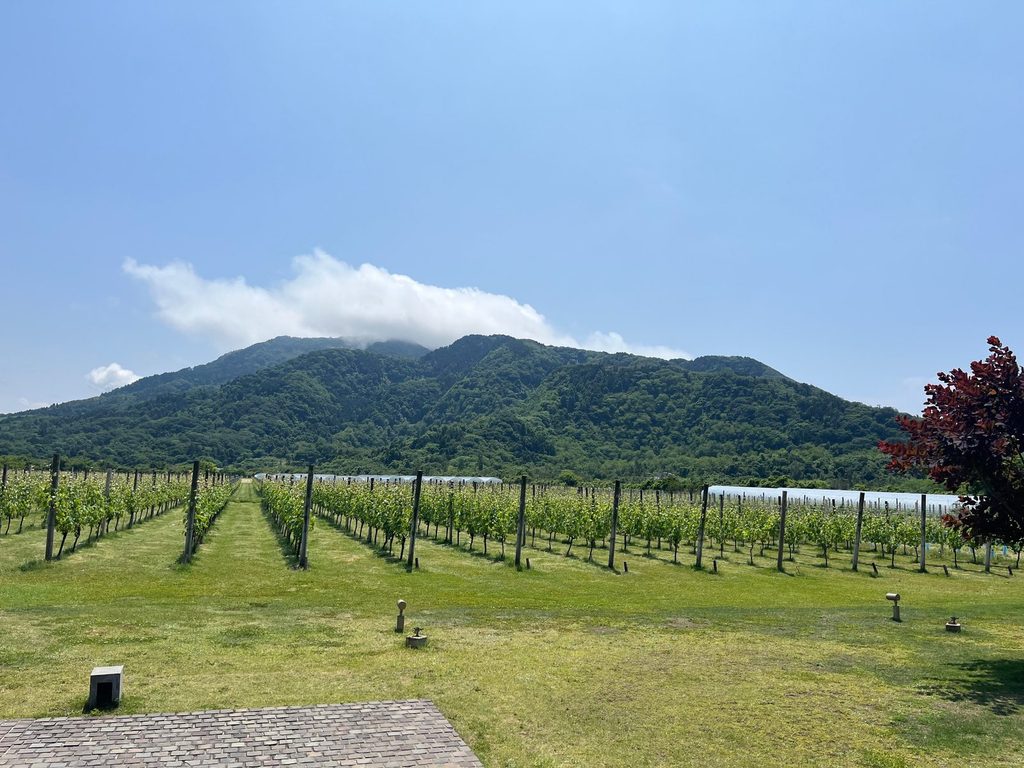
Vines on coastal sand, with cloud resting on Mount Kakuda.
Vines on sand nobody wanted
Cave d’Occi opened in 1992. Its founder, Ochi Kiichiro, trained at a state wine school in West Germany and made wine in Hokkaido and elsewhere before opening a small winery in the old town of Maki, now part of Niigata City.
The land he chose was coastal sand dune that no one had thought of planting with vines. He would not rely on imported juice or table grapes. Instead, he grew European wine-grape varieties in his own fields and made the wine himself. That idea is still the core of the winery today.
At the time, wine made from imported juice, or imported wine bottled in Japan, could still be sold as “domestic wine”. Ochi wanted the opposite: a winery ringed by its own vineyards, making wine only from grapes grown there, where visitors could see for themselves where, how and in what soil the grapes were grown.
What the sand gives
The vineyards sit about 1.5 km from the shore. Over centuries, strong winds off the Sea of Japan piled sand here up to 30 metres deep. Look down and you see fine, loose sand, much like a beach.
It is poor soil, no good for rice or vegetables. For grapes, though, it is a different story. Low in nutrients and very free-draining, it is said to produce richly aromatic fruit. The climate helps too: snow rarely settles, and after the rainy season the summers tend to be hot and dry.
Even so, sand does not become a vineyard on its own. Since the first vines went in, the team has added compost every year and let grasses grow between the rows, building the soil little by little. Over decades, dunes nobody wanted became land made for wine.
The vine owners
Money was tight in the early years. The answer was a “vine owner” scheme. For ¥10,000 a share, members received one bottle a year for ten years, and a vine in the vineyard carried their member number. They could visit and watch their own vine grow.
More than 10,000 people signed up, and the winery came through. Each vine planted in the sand took root on the hopes of people who wanted to see wine made here.
“Don’t sell in Tokyo, let Tokyo come to you”
In Germany, Ochi had seen people travel to producers to buy wine directly. His idea was not to sell in Tokyo, but to have people come from Tokyo to buy. Restaurants, shops and rooms were added one by one, and today about 300,000 people visit each year.
Ochi’s ambition went beyond one business. He wanted to make Niigata a wine region, like Hokkaido or Yamanashi. Contract farmers were asked to grow wine grapes suited to the local land, and a year-long winery management course helped others set up on their own. Several graduates have opened wineries nearby, and the cluster is now known as the Niigata Wine Coast. A region grows as a forest, not a single tree. The hope behind those first vines on the sand lives on in the wineries along this coast.
A little far, and that is the point
To be honest, Cave d’Occi takes some effort to reach. Take the Joetsu Shinkansen to Niigata, change to the JR Echigo Line for Uchino Station, then drive another 20 to 30 minutes.
The good news is that hotel guests can ride a free shuttle bus from Uchino Station. It runs daily on a first-come, first-served basis; you request a time when you book your room. As the view outside shifts from houses to rice fields and finally to vines, the tiredness of the journey slowly falls away.
I stayed at Winerystay TRAVIGNE, the small hotel on the estate. It has just ten rooms, each named after a wine in Cave d’Occi’s “animal series”.
Every room looks straight out onto the vineyard, with Mount Kakuda beyond. Leave the curtains open, sit down, and you can watch the vine leaves move in the wind for as long as you like. Here, doing nothing at all may be the best way to spend the time.
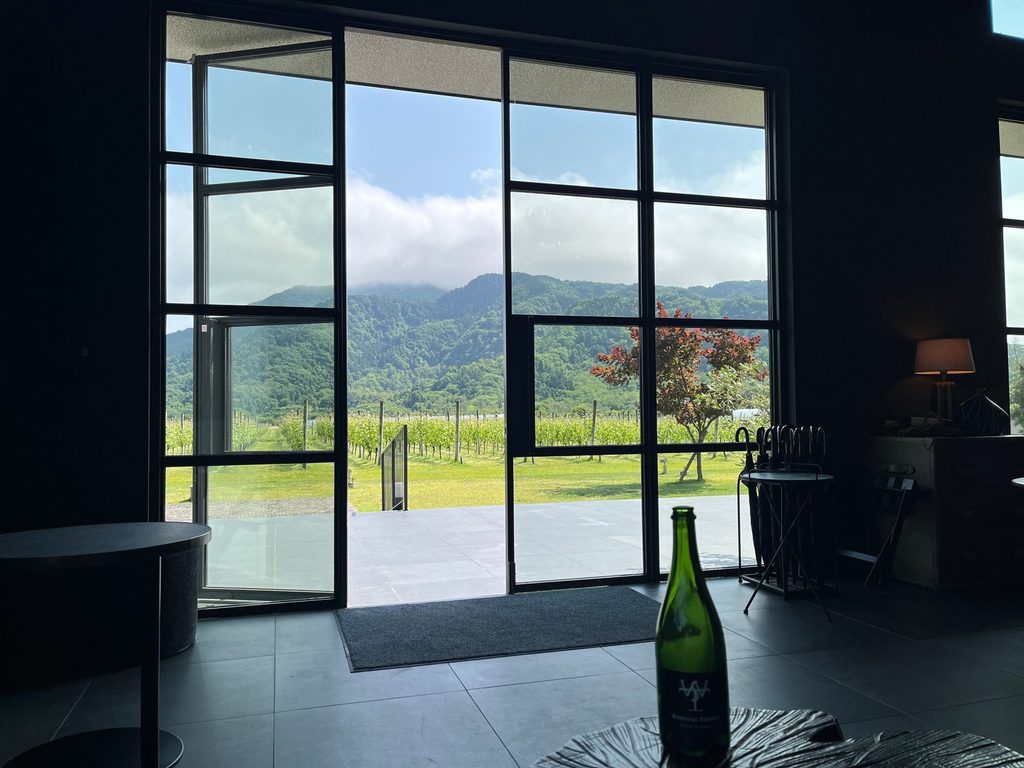
Through the tall doors of the lounge, the vineyard and the mountain again.
Like a walk through the German countryside
Step out of the hotel and you feel as if you have wandered into a small village. Shops and cafés are scattered along the paths, and roses line the way. It is not a large estate, but the buildings and gardens share a simple, rustic style that recalls the German countryside. Perhaps the founder’s years in Germany show here too.
The main places on the estate:
- Wine Shop: the full range of Cave d’Occi wines, and the starting point for winery tours.
- Cote à Cote Marché / Café: house-made bread, sausages and beer. Locals reportedly drive over just for the natural-yeast bread.
- Kaihoro: coffee beans and a café.
- Prière: natural-stone jewellery and homeware.
- Restaurants: French at Restaurant Cave d’Occi, wood-fired cooking at Makigoya, Japanese at Yuraku. All serve Cave d’Occi wine.
On a fine day, have lunch at one of the outdoor tables. A glass of wine in the early-summer sun, with the breeze coming off the vineyard, was a highlight. When I visited, many of the lunch tables were filled with older ladies chatting unhurriedly, and their easy pace suited the place perfectly.
Light, and quietly distinctive: Japanese wine
Cave d’Occi makes what is called Nihon wine (日本ワイン), “Japanese wine” in the strict sense: wine made in Japan from grapes grown in Japan. I am not a wine expert, but to me it tasted lighter than the imported wines most people picture, with a character all its own.
Part of the reason is the land. The winemakers here have worked to make the most of the sandy soil, putting particular effort into Albariño, a white grape best known from the Atlantic coast of north-west Spain.
One of their Albariño wines is called SABLE, French for “sand”, and its label is dotted with grains of sand. The winemaker’s aim, reportedly, is a wine like sand slipping through your fingers.
Not heavy, but light and easy on the body. It sits well alongside Japanese food and is easy to enjoy even at lunch. That, for me, is the charm of Japanese wine. If you have ever wondered what wine from Japan tastes like, tasting it here, in the landscape where it was made, is a fine place to start.
Winery tour: a tour of just under an hour runs daily, taking in the vineyard, the winery and the underground cellar, and ending with a tasting. Booking is required, it is for ages 20 and over, and it is guided in Japanese only. Even so, seeing where the wine comes from makes the next glass taste deeper.
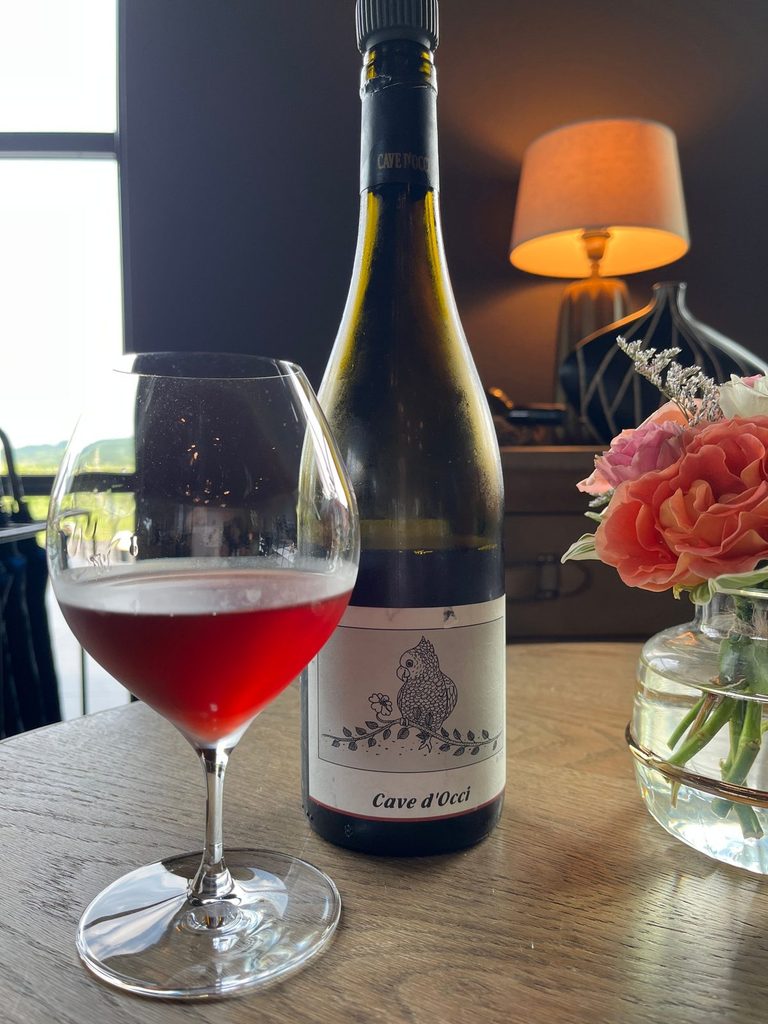
A parrot on the label, from Cave d’Occi’s “animal series”. The rooms at TRAVIGNE take their names from the same series.
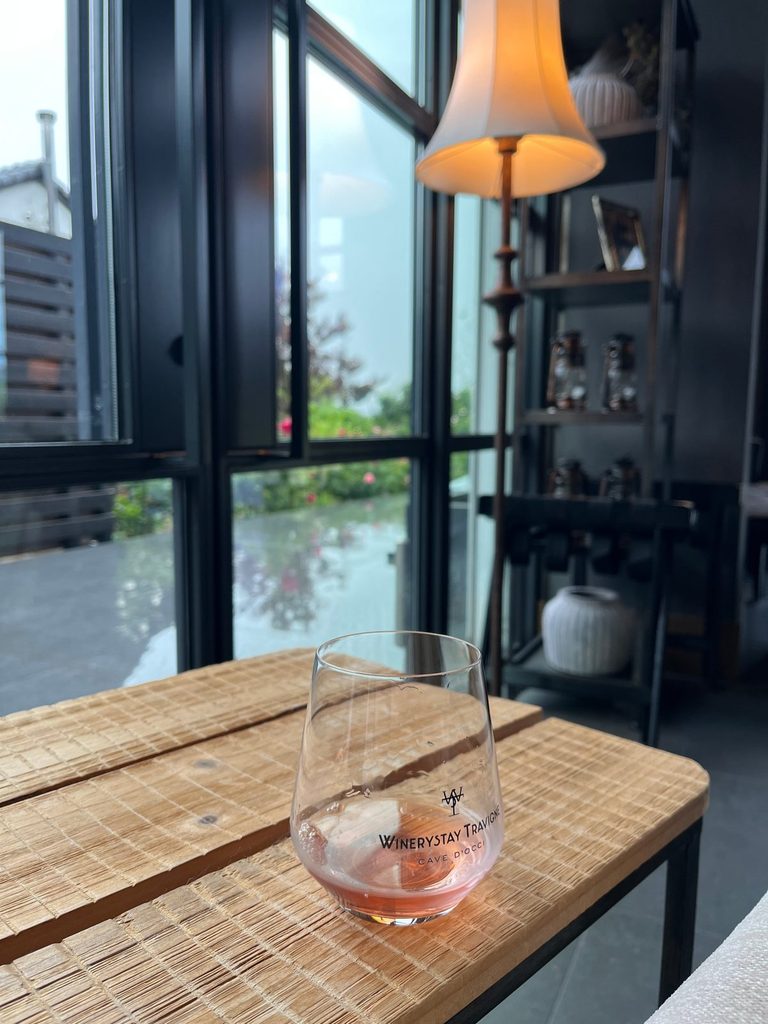
Rosé in a TRAVIGNE glass, with roses blooming just outside the window.
A special-occasion dinner in the single-storey restaurant
If you come for the wine, book a table at Restaurant Cave d’Occi, the single-storey restaurant on the estate. It serves course menus built around Cave d’Occi wines and local Niigata produce. Outside the windows, Albariño vines stretch towards Mount Kakuda.
The room looks every bit the fine-dining restaurant. Yet at the next table, three generations of a local family, grandparents included, were celebrating a birthday. Weddings are held here too, but the feeling is less formal than that suggests: this is the stylish local restaurant people choose for a special night out.
Each course comes paired with a wine. Service is in the European style, by men dressed in black, and many wear a sommelier’s pin. Asking them about each pairing is part of the pleasure.
For TRAVIGNE guests, a pairing of six Cave d’Occi wines matched to the menu has been offered for ¥6,600 (as of 2023). For wine lovers, it is an experience you can only have here.
Hot springs by the vineyard, for ¥500
TRAVIGNE itself has no hot spring. But about three minutes’ walk away, on the same estate, the same company runs VINESPA, an inn with natural hot springs (onsen) and a sauna. It is a little more affordable than TRAVIGNE, and it also welcomes day visitors.
If you are staying at TRAVIGNE, buy a ¥500 bath ticket at check-in and you can use the VINESPA baths as often as you like during your stay. A soak before dinner, another the next morning. Moving between wine and hot water like this is a rare luxury.
The water comes from two sources at the foot of Mount Kakuda. Men’s and women’s sides each have two open-air baths of different sizes with different water, an indoor bath and a sauna. Sinking into the silky water, then cooling off in the open air with the breeze from the vineyard, was one of the high points of my trip.
First time at an onsen? Baths are separated by gender, and you bathe without a swimsuit. Wash and rinse at the shower stations before you get in, and keep your small towel out of the water. Policies on tattoos vary from place to place, so check with the front desk if this applies to you.
Bath ticket prices and rules may change. Please check the latest information.
When to go: late May to early June
Both of my stays fell at the end of May and in early June, just before Japan’s rainy season (tsuyu) begins. There are three reasons I recommend this time:
- The vineyard is at its freshest. New leaves grow by the day, and the whole field glows bright green.
- The roses are out. The roses along the estate paths are at their best.
- You can be outdoors. Thanks to the dry air before the rains, lunch on the terrace and cooling off after a bath are both a pleasure.
Autumn, when the grapes ripen
Both my stays were in early summer, but next time I would like to come in autumn, when the vines I saw in fresh leaf hang heavy with coloured bunches.
Raising a glass where the wine is made, with that year’s harvest in front of you, must be a different kind of winery experience from early summer. When I go, I will add it to this story.
Before you go
- Name: Cave d’Occi Winery (カーブドッチ ワイナリー)
- Address: 1661 Kakudahama, Nishikan-ku, Niigata City, Niigata
- By train: Joetsu Shinkansen from Tokyo to Niigata, then the JR Echigo Line to Uchino Station. From Uchino, about 20–30 minutes by car.
- Shuttle bus: free for hotel guests between Uchino Station and Cave d’Occi. Runs daily; seats are limited and first-come, first-served. Request your preferred time when booking.
- Where I stayed: Winerystay TRAVIGNE. Ten rooms, all with views of the vineyard and Mount Kakuda. Check-in 15:00–18:00, check-out 11:00. Children under primary-school age cannot stay.
- With hot springs: VINESPA, an inn with natural hot springs and a sauna. Day bathing is also available.
- Hot springs for TRAVIGNE guests: buy a ¥500 ticket at check-in for unlimited bathing during your stay (from April 2026).
- Winery tour: daily at 11:00 and 15:00, just under an hour, ¥2,200. Booking required, ages 20+, Japanese only.
- Language: most information and the tour are in Japanese. A translation app helps.
- Official site: docci.com
Prices, times and rules are based on information published as of October 2026. Please check the official site before booking.
As the shuttle bus pulled away, the green of the vineyard slowly faded behind the window. Light wine grown on sand, the breeze after a bath, vine leaves filling the morning window. Back home, they still come back at unexpected moments.
It is a little far, and that is exactly why it takes you so completely away from the everyday. Cave d’Occi leaves a long yoin (余韻), the quiet afterglow that stays with you once the journey is over.