A Front-Row Seat to the Harbour Lights: Kengo Kuma’s Garden Terrace Nagasaki and the Many Lives of a Port City
*This article contains affiliate links (PR).
At dusk, the water of Nagasaki harbour slips from silver into deep indigo. Then, one by one, the lights come on — climbing the steep hillsides that wrap around the bay until the whole city glows like an amphitheatre waiting for the curtain to rise.
High on the opposite slope, in what might be the best seat in the house, sits Garden Terrace Nagasaki Hotel & Resort, designed by the architect Kengo Kuma.
What makes a night here so memorable is that the view is never just a view. Below you lies a city that has spent nearly four centuries facing the wider world — trading with it, learning from it, building ships for it, and, in 1945, suffering at its hands. To understand the stay, it helps to understand the city first.
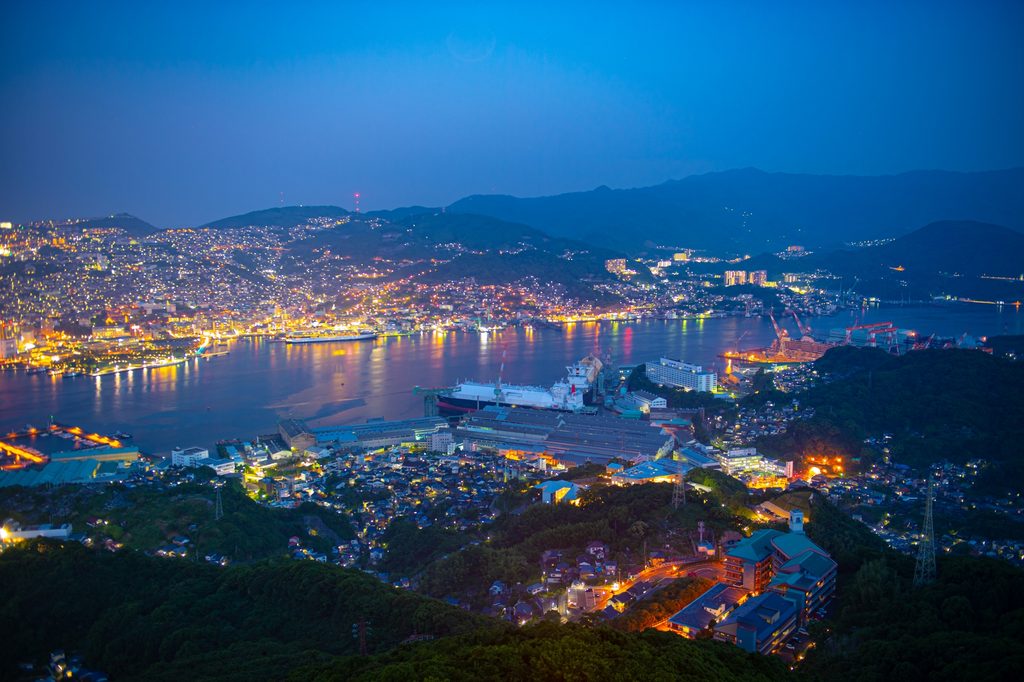
Nagasaki harbour at night from Mount Inasa. Lights fill the bowl-shaped city, and the shipyard cranes glow on the right.
Dejima: Japan’s Only Window to the West
When the Tokugawa shogunate closed Japan to most foreign contact in the 17th century, one small fan-shaped island in Nagasaki harbour remained ajar. Dejima was built to contain Portuguese traders and later became home to the Dutch East India Company’s trading post. For roughly two hundred years it was virtually the only place where Japan traded officially with Europe.
Sugar, glass, clocks — and, just as importantly, Western medicine, astronomy and science — all entered the country through this tiny man-made island. Chinese merchants, meanwhile, had their own quarter in the city, and their influence ran just as deep.
Today Dejima has been carefully reconstructed. Walk its lanes of white-walled, tile-roofed warehouses and you can still sense the curious, cosmopolitan air of a city that was Japan’s meeting point with the rest of the world.
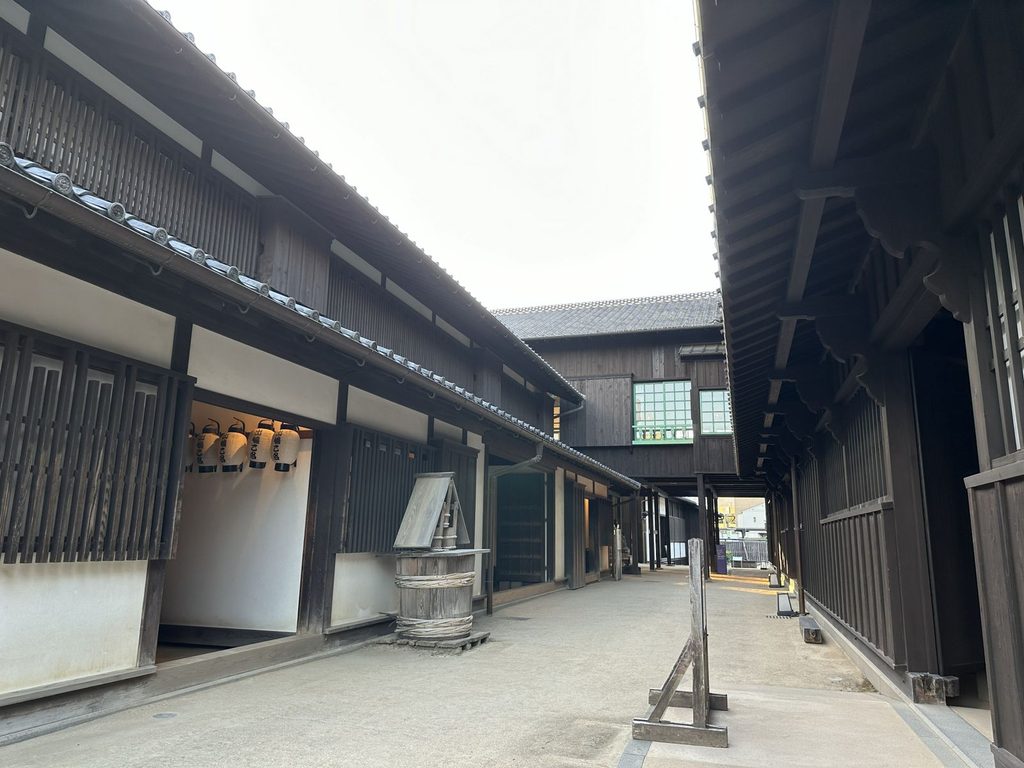
A reconstructed lane on Dejima. Beyond the white-walled, tile-roofed warehouses stands a Western-style building with green window frames and a balustrade: Japan and Holland side by side, as only Dejima could arrange.
Coal and Steel: Where Modern Japan Was Forged
In the late 19th century, Nagasaki stood at the leading edge of Japan’s rush to industrialise.
Off the coast lies Hashima, better known as Gunkanjima or “Battleship Island”. It was once a thriving undersea coal mine, its tiny surface crammed with concrete apartment blocks and, at its peak, one of the most densely populated places on earth. The mine closed in 1974 and the island was abandoned; today its weathered ruins stand silent in the sea. It also carries a darker memory: during the war, many labourers, including people mobilised from the Korean Peninsula and China, worked there under harsh conditions — a history worth holding in mind when you visit.
Across the harbour from the hotel stretches the Mitsubishi Nagasaki Shipyard, whose origins go back to a shogunate-era ironworks. Countless great ships were launched here, including the battleship Musashi. The Giant Cantilever Crane, installed in 1909, is still in service and remains part of the harbour’s skyline.
In 2015, Hashima and parts of the shipyard were inscribed on the UNESCO World Heritage List as part of the Sites of Japan’s Meiji Industrial Revolution. Look out from your room and those cranes become quiet witnesses to the birth of modern Japan.
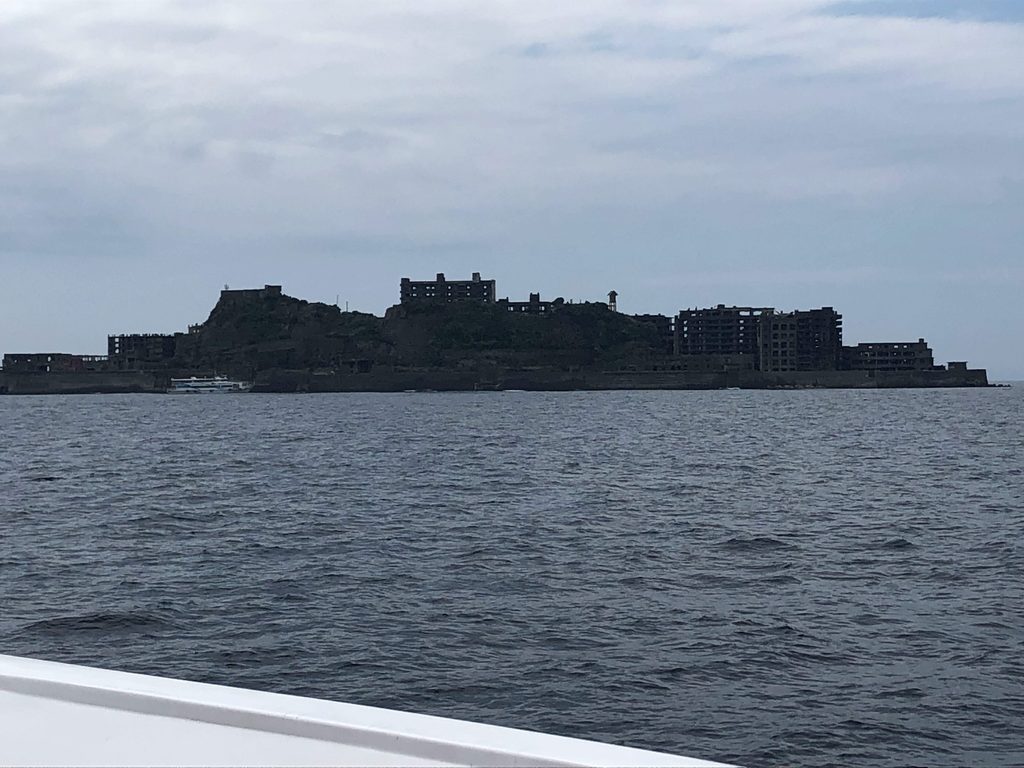
Hashima from the deck of a cruise boat. Even at a distance, you can make out the tightly packed apartment blocks.
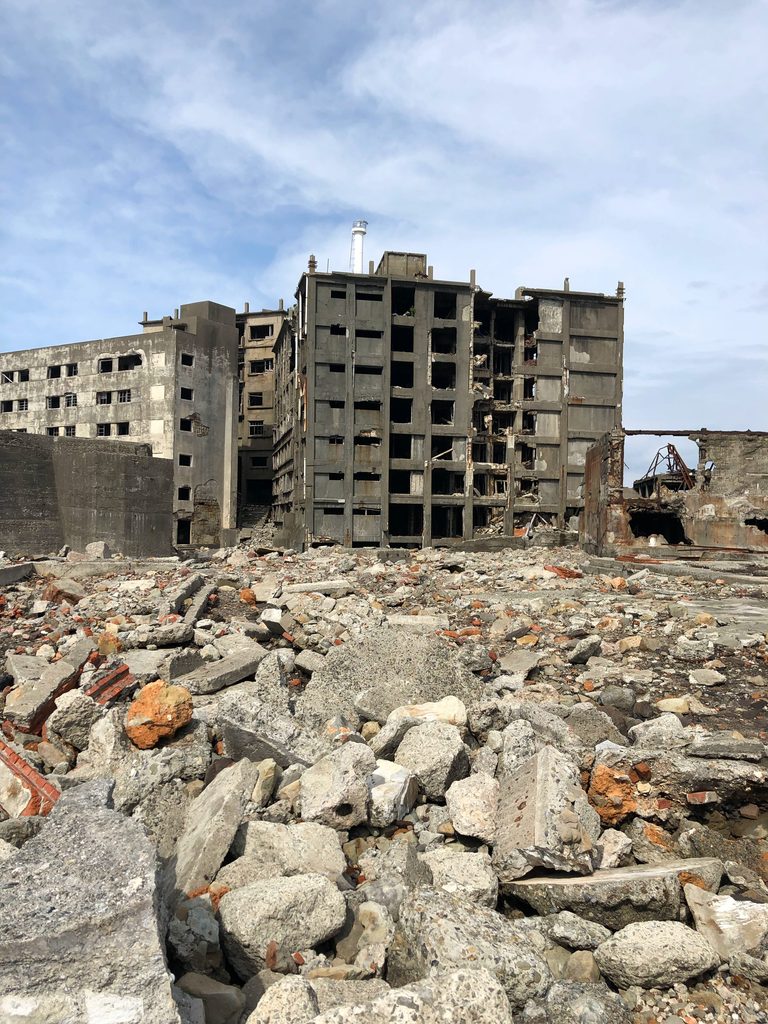
On a landing tour, weathered buildings rise beyond the rubble. Half a century after the last residents left, the silence is striking.
11:02 a.m., 9 August 1945: A City of Prayer
At 11:02 on the morning of 9 August 1945, an atomic bomb exploded over the Urakami district of Nagasaki. By the end of that year, around 74,000 people had died.
Urakami had long been home to Japan’s Catholic community, including descendants of believers who had kept their faith in secret through centuries of persecution. Urakami Cathedral was almost entirely destroyed; the scorched head of a Madonna statue that survived the blast is still preserved today.
Nagasaki has chosen to carry this memory forward through prayer and a steady call for peace. A visit to Peace Park and the Nagasaki Atomic Bomb Museum is sobering but deeply moving. In 2018, the story of the city’s persecuted faithful was also recognised by UNESCO as the Hidden Christian Sites in the Nagasaki Region.
If you can, make time for these places. That night, the lights below your terrace may look a little different.
Wa-Ka-Ran: A Culture Unlike Anywhere Else in Japan
Locals sometimes describe Nagasaki’s culture as wakaran — a blend of wa (Japanese), ka (Chinese) and ran (Dutch). It is the character of a port city that, rather than rejecting the foreign, quietly folded it into everyday life.
- Shippoku cuisine — a banquet served on a round table and shared from large platters, mixing Japanese, Chinese and Western influences.
- Champon and sara udon — hearty noodle dishes said to have been created to give Chinese students a cheap, nourishing meal.
- Castella — a sponge cake introduced by the Portuguese and perfected in Nagasaki over centuries.
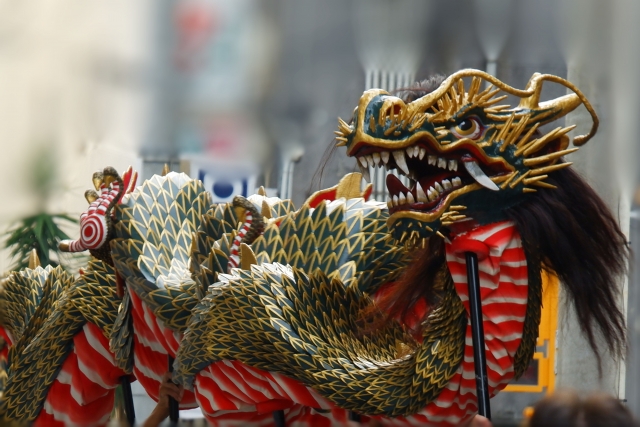
- Nagasaki Kunchi — the autumn festival of Suwa Shrine, held every year from 7 to 9 October, famous for its dragon dance and spectacular floats.
- Shoro Nagashi — a summer Obon procession in which families send off the spirits of the departed on decorated boats, amid the crackle of firecrackers.
It is this depth of layering that gives Nagasaki its particular yoin — the lingering resonance you carry home.
Halfway Up Mount Inasa: The Best Seat in the Theatre
Garden Terrace Nagasaki sits halfway up Mount Inasa, about ten minutes by car from JR Nagasaki Station, on the far side of the harbour from the old town. From here you face the city’s night view head-on — a panorama named, alongside Monaco and Hong Kong, as one of the “New Three Great Night Views of the World”.
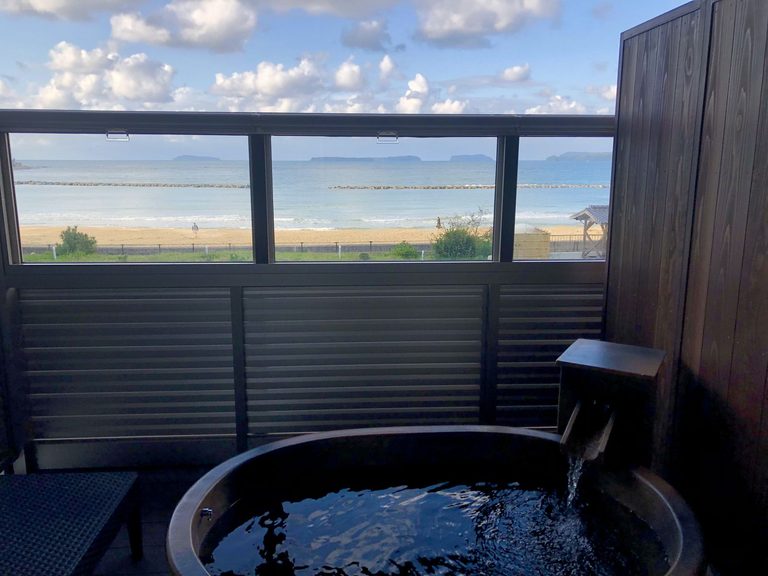
Every room is an ocean-view suite. Beyond the main building, the grounds hold several separate wings and cottage-style buildings, each with its own character, so a stay can feel more like a private holiday home than a hotel. From the terraces — and even the bathtubs — you can pick out landmarks such as Oura Cathedral and Glover Garden across the water.
There is an infinity pool overlooking the harbour, and restaurants spanning sushi, teppanyaki and creative cuisine that weaves together Japanese, Western and Chinese influences — wakaran on a plate, built around local seafood and Nagasaki wagyu.
In 2023 the hotel added the View Terrace building, designed to appear as though it floats on a shallow pool of water. Deep sofas line its terrace and lounge, creating the feel of a living room where time seems to slow down.
Kengo Kuma and the Art of “Defeated Architecture”
Kengo Kuma, born in 1954, is one of Japan’s most celebrated architects, with projects across the globe — most famously the Japan National Stadium, centrepiece of the Tokyo 2020 Olympic and Paralympic Games.
His approach is often summed up by the title of one of his books, Makeru Kenchiku — roughly, “Defeated Architecture”. The idea is that a building should not dominate its surroundings, but yield to them: dissolving into the landscape, letting the site and its materials take the lead. His delicate use of wood and stone, and the way his buildings filter light and air, are that philosophy made physical.
At Garden Terrace Nagasaki, the star is not the building but the city. In the main building, windows of many sizes frame the harbour like a series of paintings. The newer View Terrace building takes the opposite approach, opening outwards in an unbroken line of sight to the bay. Kuma’s studio describes Nagasaki as a “theatre city” encircling its bay, and this building as a new “special seat” from which to watch the show.
Look directly across the harbour and you will spot the Nagasaki Prefectural Art Museum, which straddles a canal by the waterfront — another Kuma design. Two works by the same architect, facing each other across the water, is a small pleasure unique to this spot.
The hotel also offers guided architecture tours that explain the details of Kuma’s design (check availability in advance) — a must for anyone with an eye for buildings.
How to Spend One Slow Night
Day 1
- Afternoon: Wander Dejima and the streets around Oura Cathedral; pick up a box of castella.
- Sunset: Check in and settle by the pool or on your terrace as the sky changes colour.
- Evening: Dinner overlooking the harbour, then dim the room lights and simply watch the city glow.
Day 2
- Morning: A quiet breakfast with the harbour in morning light.
- Late morning: Join the in-house architecture tour, or visit Peace Park and the Atomic Bomb Museum.
- Afternoon: Cross to the Nagasaki Prefectural Art Museum and look back up at the hotel from the other side.
Essentials
- Name: Garden Terrace Nagasaki Hotel & Resort
- Address: 2-3 Akizuki-machi, Nagasaki City, Nagasaki Prefecture
- Access: About 10–15 minutes by car from JR Nagasaki Station (shuttle available, reservation required); about 20 minutes from Nagasaki IC
- Check-in / Check-out: 16:00 / 12:00
- Facilities: Outdoor pool, restaurants, bar, rooms with open-air baths
- Parking: Available
Rates, hours, shuttle service and tours are subject to change. Please check the official website for the latest information.
Reserve your stay at Garden Terrace Nagasaki
The booking page opens in Japanese — simply select “English” from the language menu to view rooms and complete your reservation in English.
Closing Thoughts
A window opened to the world at Dejima; a modern nation dug out from beneath the sea; a city that rebuilt itself through prayer. Perhaps Nagasaki’s night view moves people so deeply because so many stories lie quietly beneath those lights.
Take your seat in the “special seat” Kengo Kuma created on Mount Inasa, and spend an evening simply watching the harbour glow. It is the kind of night whose resonance stays with you long after the journey ends.