Tasting Niigata, One Small Cup at a Time — Ponshukan at Echigo-Yuzawa Station
Step off the shinkansen at Echigo-Yuzawa and walk through the ticket gates. Somewhere nearby, the air smells faintly of steamed rice and koji. This is Ponshukan (ぽんしゅ館), a shop devoted to the food and sake of Niigata. Tucked inside is the Kikizake Banjo (唎酒番所, “the sake-tasting station”), where you pour your own cups of sake from breweries across the prefecture.
Niigata has more sake breweries than any other prefecture in Japan. Here, you can travel through them without leaving the station. This is a guide to finding your way, and your own taste, among the cups.
How the tasting station works
The tasting station opened here in 1995. A wall of tasting machines holds 129 sakes at the Echigo-Yuzawa shop: each brewery’s signature label, plus seasonal and hard-to-find bottles that rotate through.
The ritual is simple:
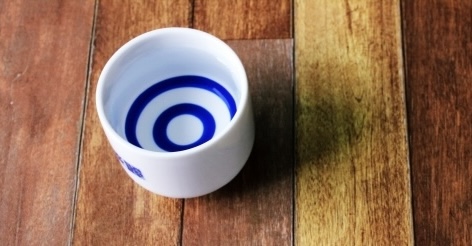
- Pay at the counter. You receive a small cup (ochoko, お猪口) and five tokens.
- Choose a sake from the machines.
- Insert a token and press the button. One small pour fills your cup.
Five tokens cost ¥1,000 (tax included), raised on July 1, 2026 from the ¥500 price held for 31 years. Some premium sakes take two tokens per pour. On the boards they are marked with a pink circle reading コイン2枚 (“2 coins”).
With the new price came new ways to taste: 50 themed tasting courses (from “Your first sake” to “Pairs with cheese”), a sake concierge who helps you choose (not always on duty), food pairings, and a comparison of the same sake in different cup shapes.
Three scales to find your taste
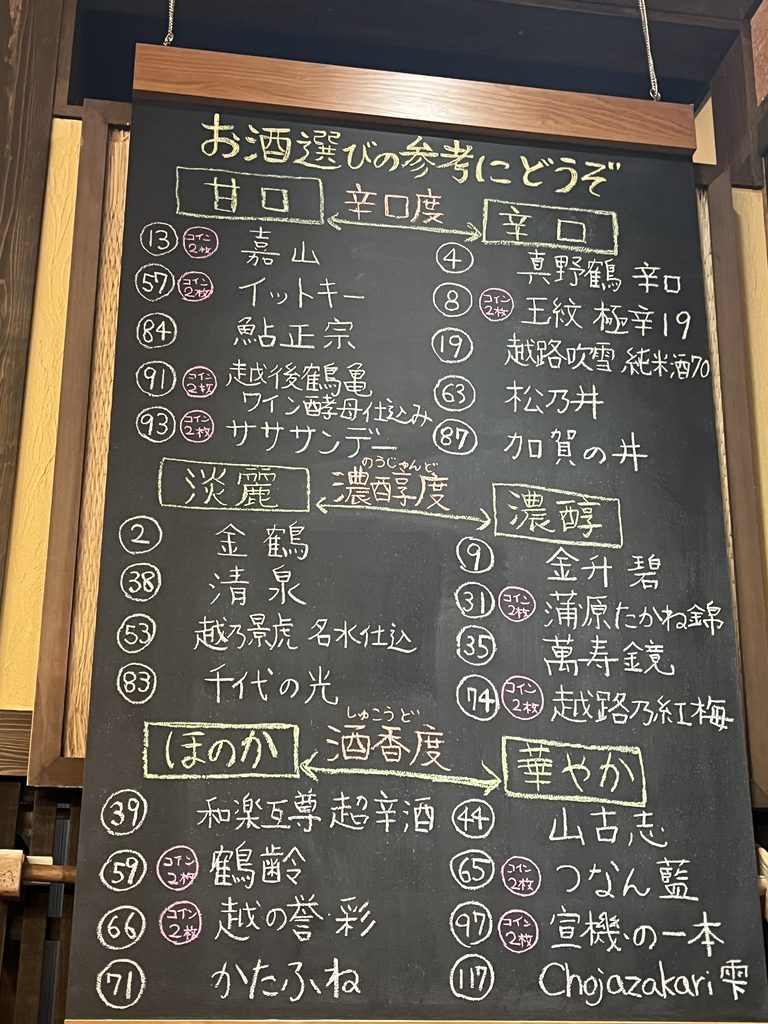
Faced with 129 choices, everyone hesitates. The chalkboard near the entrance helps. It sorts sakes along three scales.
| Scale (Japanese) | One end | Other end | Examples on the day of our visit (machine no.) |
|---|---|---|---|
| 辛口度 Karakuchi-do, dryness | 甘口 amakuchi, sweet | 辛口 karakuchi, dry | Sweet: Kazan 嘉山 (13), Ayumasamune 鮎正宗 (84) / Dry: Manotsuru Karakuchi 真野鶴 辛口 (4), Kaganoi 加賀の井 (87) |
| 濃醇度 Nojun-do, body | 淡麗 tanrei, light and clean | 濃醇 nojun, rich and full | Light: Kinkaku 金鶴 (2), Chiyonohikari 千代の光 (83) / Rich: Kinmasu Midori 金升 碧 (9), Manjukagami 萬寿鏡 (35) |
| 酒香度 Shuko-do, aroma | ほのか honoka, subtle | 華やか hanayaka, fragrant | Subtle: Kakurei 鶴齢 (59), Katafune かたふね (71) / Fragrant: Yamakoshi 山古志 (44), Tsunan Ai つなん藍 (65) |
A good way to spend five tokens: taste both ends of a scale. One sweet and one dry, one light and one rich. Tasting the opposite shows you which side you lean toward. Spend the last token on another cup from the side you liked. You leave with a clue for choosing sake anywhere in Japan.
Reading the staff’s notes
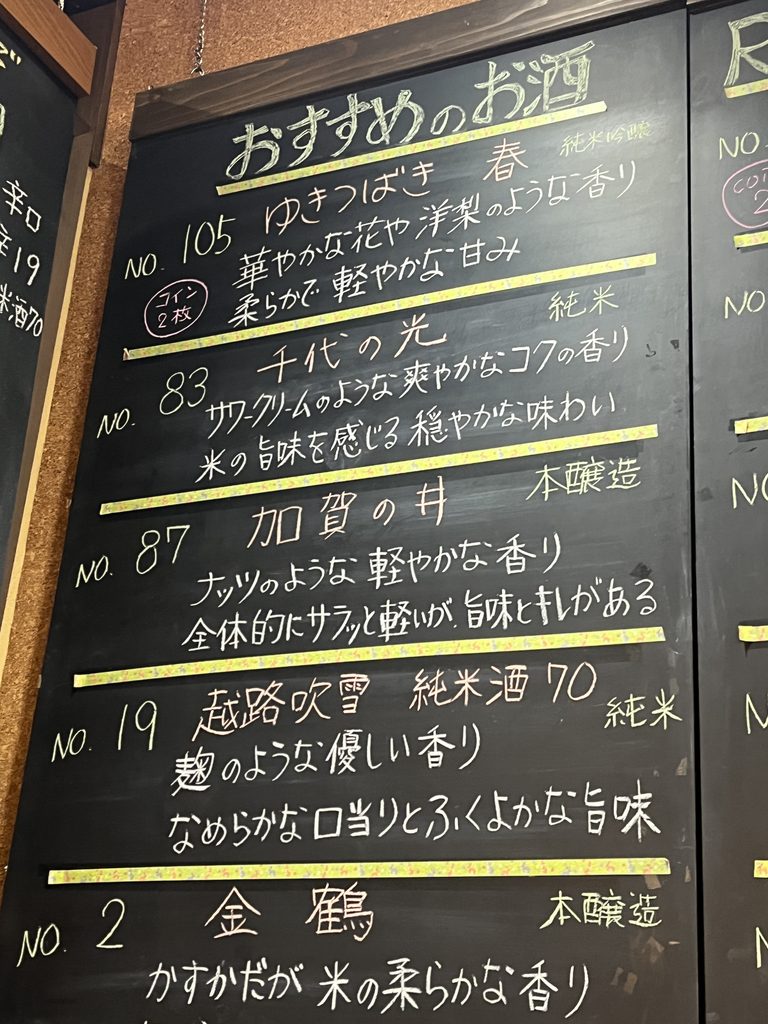
The next board lists staff picks with tasting notes. Translated:
- Yukitsubaki Haru ゆきつばき 春 (105, junmai ginjo, 2 tokens): showy floral and pear-like aroma; soft, with a light sweetness
- Chiyonohikari 千代の光 (83, junmai): a fresh, rich aroma like sour cream; gentle, with the savoury depth of rice
- Kaganoi 加賀の井 (87, honjozo): a light, nutty aroma; smooth and light, yet with umami and a clean finish
- Koshijifubuki Junmaishu 70 越路吹雪 純米酒70 (19, junmai): a gentle, koji-like aroma; silky on the tongue, with a round umami
Pear, sour cream, nuts. Hold one of these words in mind as you sip, and the aroma comes into focus. Afterwards, try describing the cup in your own words.
Labels in brief: junmai (純米) is made from rice, koji and water only; ginjo (吟醸) uses rice polished further for a more fragrant style; honjozo (本醸造) adds a little distilled alcohol for a lighter, crisper finish.
The numbers lead to a map
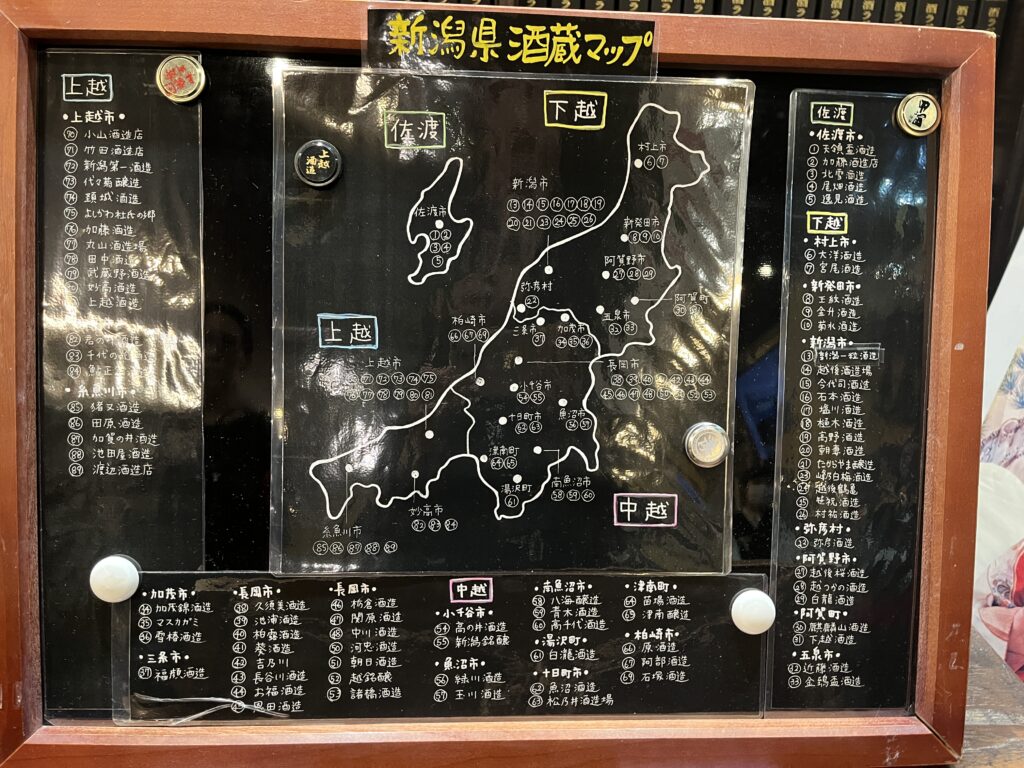
Follow the machine numbers and you arrive at the Niigata Brewery Map on the wall. It divides the prefecture into four regions: Sado (佐渡) island, and Kaetsu (下越), Chuetsu (中越) and Joetsu (上越) on the mainland. Each brewery is numbered and placed. No. 83, Chiyonohikari, comes from Myoko in Joetsu; No. 87, Kaganoi, from the coastal town of Itoigawa.
After each cup, find its brewery on the map. Is it by the sea, or deep in snow country? Knowing the place changes how a sake tastes. If you are travelling on through Niigata, a favourite cup can become your next stop.
When you cannot decide
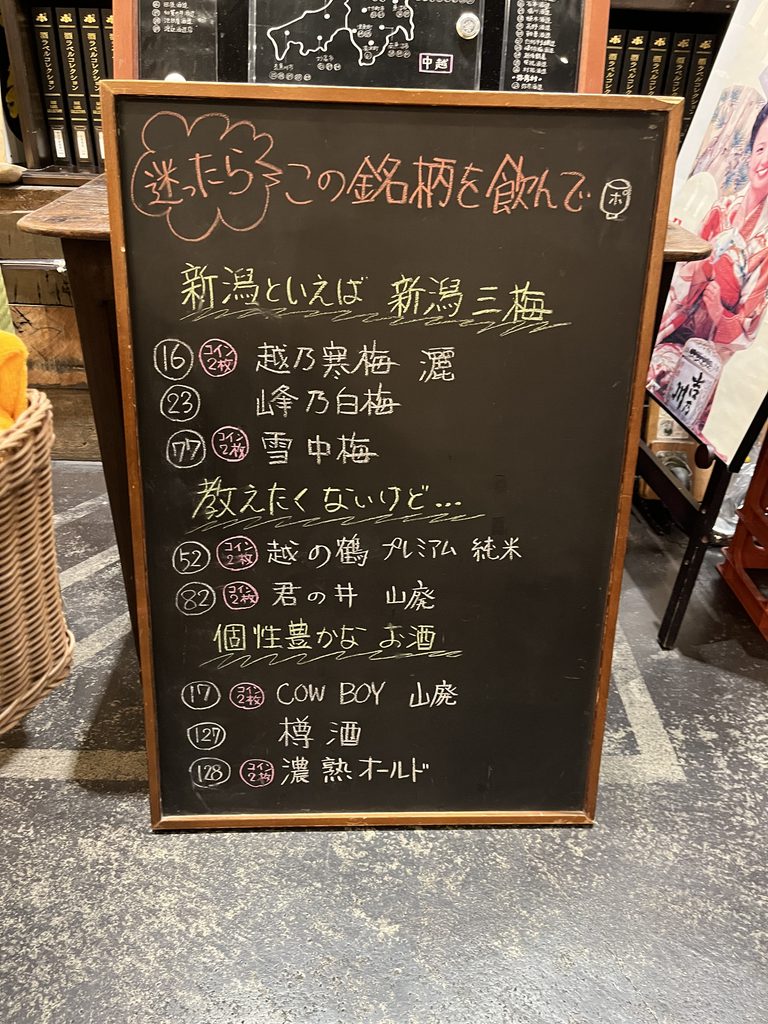
This board is written for exactly that moment.
- 新潟といえば新潟三梅, “Niigata means the Three Plums”: Koshinokanbai Sai 越乃寒梅 灑 (16, 2 tokens), Minenohakubai 峰乃白梅 (23), Setchubai 雪中梅 (77, 2 tokens)
- 教えたくないけど…, “We’d rather keep these secret, but…”: Koshinotsuru Premium Junmai 越の鶴 (52, 2 tokens), Kiminoi Yamahai 君の井 山廃 (82, 2 tokens)
- 個性豊かなお酒, “Sake with character”: COW BOY Yamahai (17, 2 tokens), Taruzake 樽酒, cedar-cask sake (127), Nojuku Old 濃熟オールド, a rich aged sake (128, 2 tokens)
New to sake? Start with one of the Three Plums. Already a fan? Pick one with character. After the clean lines of the Plums, a cedar-scented taruzake or a honeyed aged sake shows that Niigata is more than its famous light, dry style.
Letting it linger
After tasting, look for your favourite in a 720 ml bottle in the shop. Rest with a bakudan onigiri (爆弾おにぎり, “bomb rice ball”), a large rice ball of Minamiuonuma Koshihikari rice cooked in a traditional iron pot. With time to spare, try the sakeburo (酒風呂), a bath of hot-spring water mixed with sake made for bathing (¥950, age 13 and over).
Before you go
- Where: inside JR Echigo-Yuzawa Station, CoCoLo Yuzawa, 2427-3 Yuzawa, Yuzawa-machi, Niigata
- Hours: about 9:30–19:00 (varies by season and day)
- Price: ¥1,000 for five tokens
- Age: no entry to the tasting station under 20, or with children
- Between trains: allow about 30 minutes to taste without hurrying
- Check current hours on the official Ponshukan site
Five cups, five corners of Niigata. A short pause in a station becomes a lingering taste that rides home with you.