The Luxury of Waiting for Dusk: A Night at Hagi Ichirin, a Seaside Onsen Ryokan in Hagi
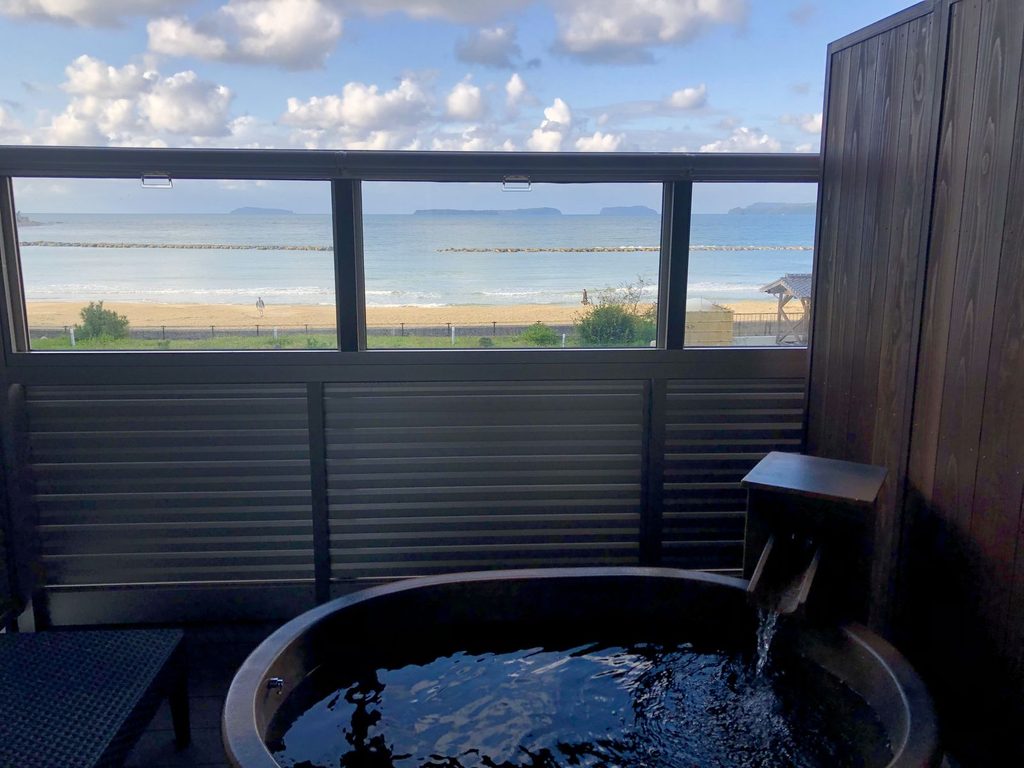
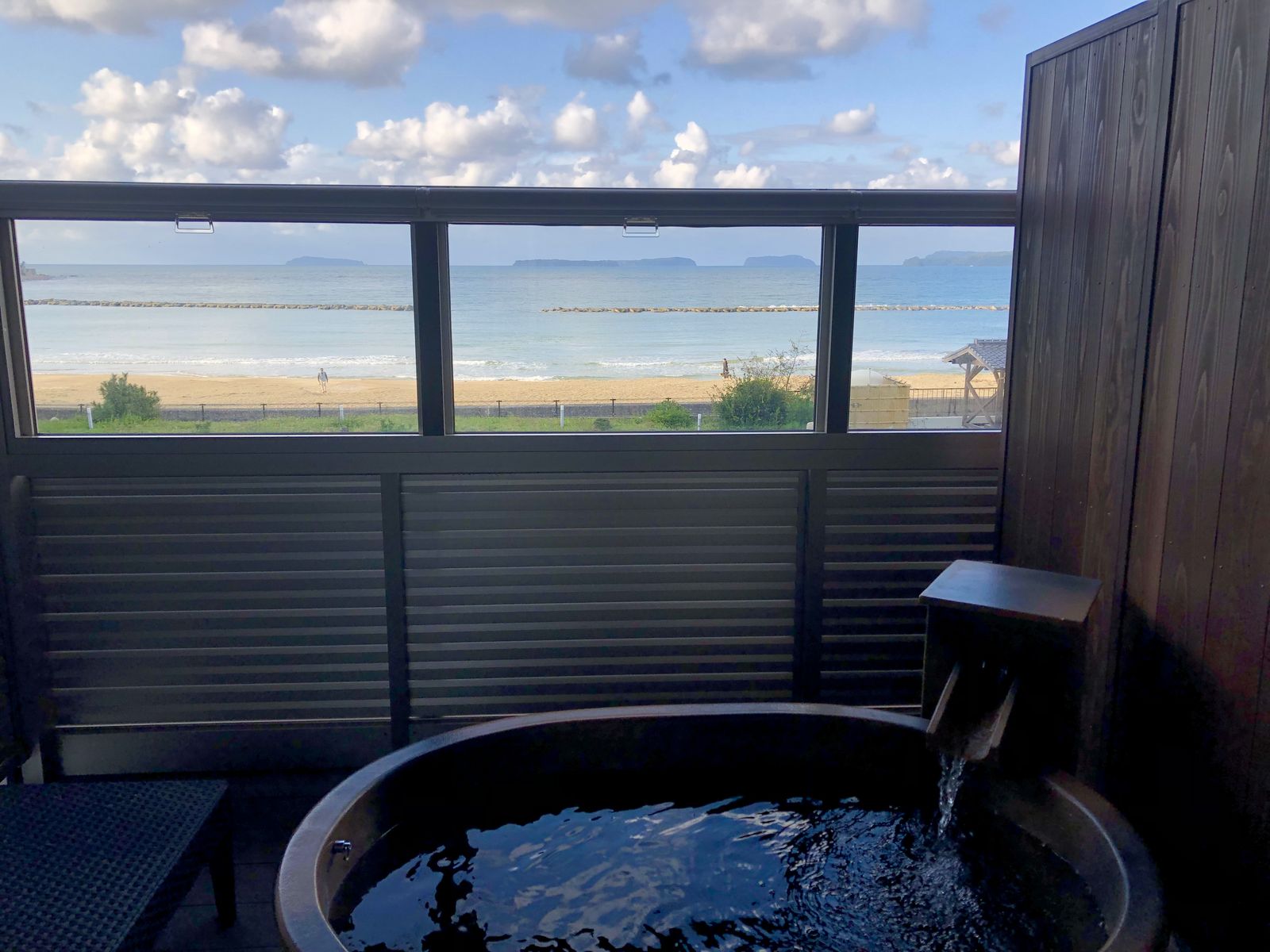
From a guest room’s private open-air bath: beyond the ceramic tub lie the white sands of Kikugahama and islands scattered across the Sea of Japan.
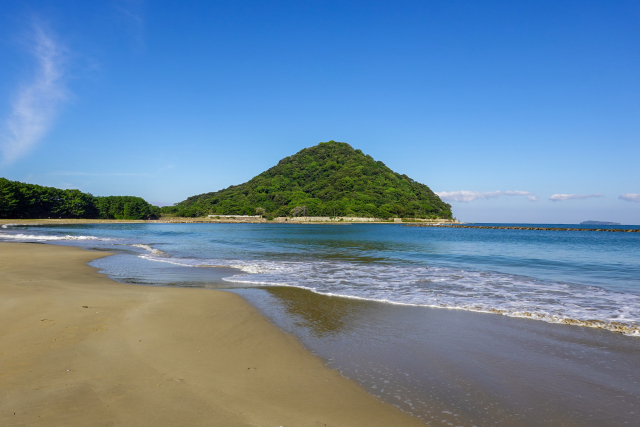
On the northern edge of Hagi, a crescent of white sand curves along the Sea of Japan. This is Kikugahama. Beyond its pine trees, the sea lies calm, and offshore islands float on the horizon like brushstrokes in an ink painting.
Right on this beach stands Hagi Ichirin, or more fully, Yoimachi no Yado Hagi Ichirin. Yoimachi means “waiting for the evening”: that quiet hour when the day fades and night slowly arrives. Soaking in hot spring water while the sun melts into the sea, you begin to understand that the name is less a label than an invitation.
In this article, we explore Hagi, a former samurai stronghold and the birthplace of Japan’s modernisers, and spend a slow night at Hagi Ichirin.
Hagi: A Castle Town That Shaped Modern Japan
Drive to Hagi from Yamaguchi Ube Airport and, for a long stretch, the road winds through quiet hills and farmland. Then, the moment you reach Hagi, the atmosphere changes. Neatly ordered streets, lanes lined with earthen walls, signboards marking historic sites on every corner. It feels as though, at the end of a country road, you have suddenly stepped into a place of culture. Hagi’s history explains why.
After defeat at the Battle of Sekigahara in 1600, the powerful Mori clan lost most of its territory and moved its seat to Hagi, on the remote Sea of Japan coast. In 1604, Mori Terumoto built Hagi Castle at the foot of Mount Shizuki, beginning some 260 years of rule over the Choshu domain.
Walking through Hagi today, you will find the Edo-period town remarkably intact: samurai residences behind earthen walls, white plaster walls patterned with namako tiles, and a grid of streets so unchanged that people say you can still navigate with an old map.
In the closing years of the shogunate, a small private school in Hagi, Shoka Sonjuku, run by the scholar Yoshida Shoin, produced many of the young men who would go on to lead the Meiji Restoration, including Takasugi Shinsaku and Ito Hirobumi, Japan’s first prime minister. In 2015, Shoka Sonjuku, Hagi’s castle town and the Hagi Reverberatory Furnace were inscribed as part of the UNESCO Sites of Japan’s Meiji Industrial Revolution, the same listing that includes Nagasaki’s Hashima Island and shipyard.
🔗 Related: A Front-Row Seat to the Harbour Lights: Kengo Kuma’s Garden Terrace Nagasaki
Why Did So Many Revolutionaries Come From Hagi?
How did one small castle town produce so many of the figures who brought down the shogunate? There is no single answer, but historians often point to a few factors:
- A culture of learning: In 1719, the Choshu domain founded its own school, Meirinkan, and invested heavily in education. Yoshida Shoin himself is said to have lectured there at the age of nine.
- A school open to all: While Meirinkan admitted only the sons of higher-ranking samurai, Shoin’s Shoka Sonjuku welcomed students regardless of rank or age. He taught there for less than two years, yet his belief that people of conviction should rise up whatever their status lit a fire in his students.
- An outward-looking domain with resources: Home to the strategic port of Shimonoseki, Choshu built up wealth from maritime trade and stayed alert to events overseas (more below).
The Port of Shimonoseki and a Hidden Reserve
Much of Choshu’s strength came from Shimonoseki, on the Kanmon Strait. Linking the Sea of Japan with the Seto Inland Sea, this port drew ships and cargo from all over Japan, including the kitamaebune merchant ships that sailed the Sea of Japan coast. During the Tenpo-era reforms of the 1830s and 1840s, the official Murata Seifu set up the Koshinikata, an office that lent money to ships from other domains calling at the port. In effect, the domain ran a harbourside financial business.
Choshu also had a special account called the Buikukata, established in 1763. Funded by the extra rice yield revealed in a land survey, it invested in new farmland, land reclamation and local products such as paper, salt and wax, and it banked profits from ventures like the Koshinikata. Kept apart from the domain’s regular finances, it was a kind of secret reserve. It is said that this reserve allowed Choshu to act boldly in the 1860s, even when its ordinary budget was in deficit.
A port where people, goods and news all passed through, and a domain that quietly saved what it earned: the sea gave Choshu the means that let its young revolutionaries act so boldly. In this, it has something in common with Nagasaki, which looked out on the world from Dejima.
Education, ideas and a gaze turned towards the world beyond the sea: perhaps the dignified air you sense in Hagi’s streets is what remains of all three.
A Front-Row Seat on Kikugahama Beach
Hagi Ichirin sits right on Kikugahama, a short distance from Mount Shizuki and the ruins of Hagi Castle. The beach is listed among Japan’s Top 100 Sunset Spots, and on clear evenings the sun sinks into the Sea of Japan, turning the water to gold.
The sand is just steps from the door, yet Hagi’s historic castle town, including the Hagi Museum and samurai district, is within walking distance. Seaside resort and historic town, both in one stay: that is the real advantage of this location.
The tea lounge also looks out over the sea and Mount Shizuki. Arrive, settle in, and simply wait as the colours of the sea begin to shift towards evening.
Private Open-Air Baths and the Inn’s Own Hot Spring
The heart of Hagi Ichirin is its water. The inn offers 15 types of rooms with private open-air baths, alongside modern Japanese-Western rooms, designer rooms and traditional Japanese rooms.
In the room we stayed in, a round ceramic tub sat on the balcony, with hot spring water flowing in constantly. Sink in, and at eye level you see white sand, blue sea and distant islands. Morning, afternoon or late at night, you can bathe whenever you like to the sound of the waves. Few luxuries compare.
The communal baths draw on the inn’s own hot spring source, with open-air baths (including ceramic tubs), semi-open-air baths and indoor baths. The men’s and women’s baths swap daily, so a two-night stay lets you try them all. There is also a private cypress-wood family bath and a footbath terrace where you can cool off in the sea breeze.
The Bounty of Sea and Land
Dinner is a creative kaiseki course built around local seasonal ingredients, such as Kenran beef (a Yamaguchi wagyu brand), abalone and nodoguro (blackthroat seaperch), a prized fish of the Sea of Japan.
Beyond Hagi: Motonosumi Shrine
If you are travelling by car, head west along the Sea of Japan coast.
In Nagato City, Motonosumi Shrine sends a line of 123 vermilion torii gates winding down a clifftop towards the sea, a view CNN named among the 31 most beautiful places in Japan. The gates are currently under repair and the shrine closes on some days, so check before you go. We cover its story, highlights and visiting tips in a separate article.
🔗 Related: Vermilion Prayers to the Sea: The 123 Torii Gates of Motonosumi Shrine
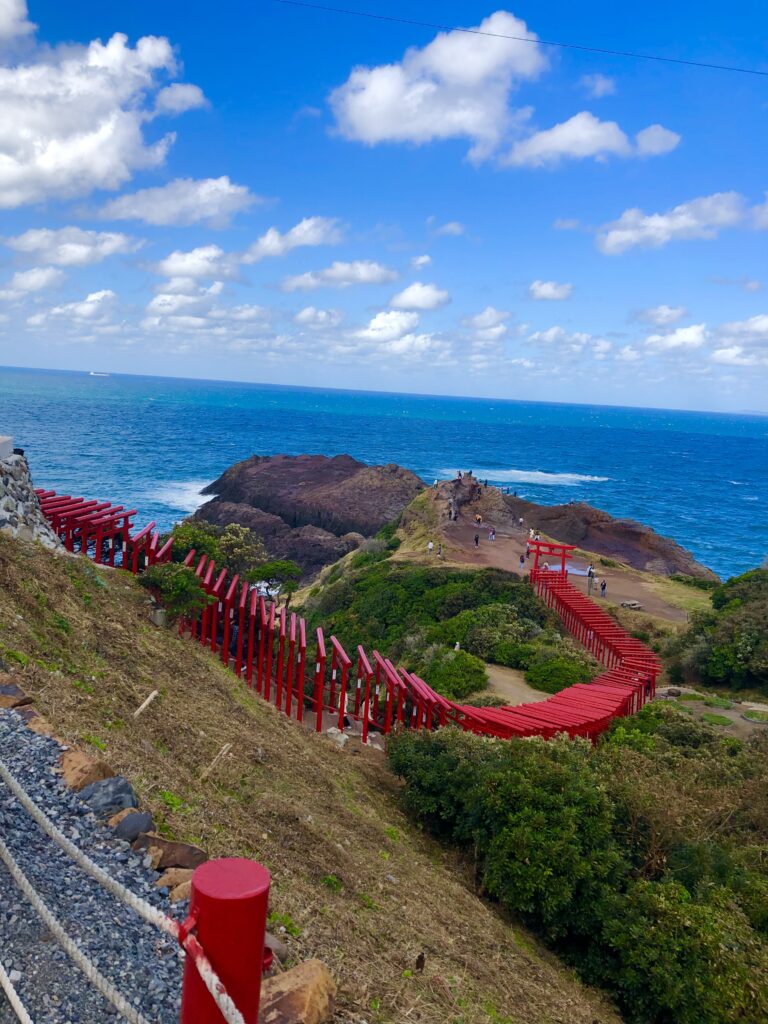
A line of red torii gates descending to the Sea of Japan. The contrast with the blue water is breathtaking.
How to Spend One Slow Night
Day 1
- Afternoon: Stroll Hagi’s castle town, visit the samurai district and Shoka Sonjuku.
- Evening: Check in to Hagi Ichirin and wait for the sunset over Kikugahama from your private bath.
- Night: A creative kaiseki dinner, followed by a tour of the communal baths.
Day 2
- Morning: A morning soak, then a slow walk along Kikugahama.
- Late morning to afternoon: Drive west to Motonosumi Shrine along a scenic stretch of the Sea of Japan coast.
Essentials
- Name: Hagi Onsenkyo Yoimachi no Yado Hagi Ichirin
- Address: 482-2 Horiuchi (Kikugahama), Hagi, Yamaguchi Prefecture
- Phone: +81 838-25-7771
- Access: Free shuttle from JR Higashi-Hagi Station (reservation required); about 25 minutes by car from Eto IC on the Ogori-Hagi Road
- Check-in / Check-out: 15:00 / 10:00
- Facilities: Rooms with private open-air baths, communal baths (own hot spring), private family bath, footbath terrace, tea lounge, shop
- Parking: Available
Rates, shuttle service and facilities are subject to change. Please check the official website for the latest information.
Closing Thoughts
A castle town of the Mori clan and the cradle of Japan’s modernisers: Hagi’s quietness carries the weight of all that time.
At the edge of town, on a white beach, you sink into the water and simply wait for the sun to set. A night at Hagi Ichirin settles into you slowly and stays long after you have gone home.