Kagi-mochi: A Soft, Quiet Sweet from Gion for Special Days
*This article contains affiliate links (PR).
Some sweets are made to impress. Kagi-mochi is made to be shared quietly, around a low table, with a pot of tea and nowhere else to be.
This New Year, I am sending a box of it to my parents’ home. It comes from Kagizen Yoshifusa, a confectioner that has stood in Kyoto’s Gion district for roughly 300 years. Nothing about it is showy: a thick, soft square of gyuhi — a smooth, tender dough of rice flour and sugar — buried in toasted soybean flour. Yet it is the sweet I reach for when a day deserves to feel a little special.
That is also what draws me to Kagizen. It has kept its old sweets almost exactly as they were, while each generation has tried something new around them: a craftsman’s shelf, a tearoom, a café, a museum.
I still remember the first time I ate one. I am approaching fifty, and I had quietly assumed that I already knew most of the good things there are to eat. Kagi-mochi proved me wrong. It suited my taste so exactly that I was genuinely surprised — that something so perfectly mine had been here in Japan, right at my feet, all along.
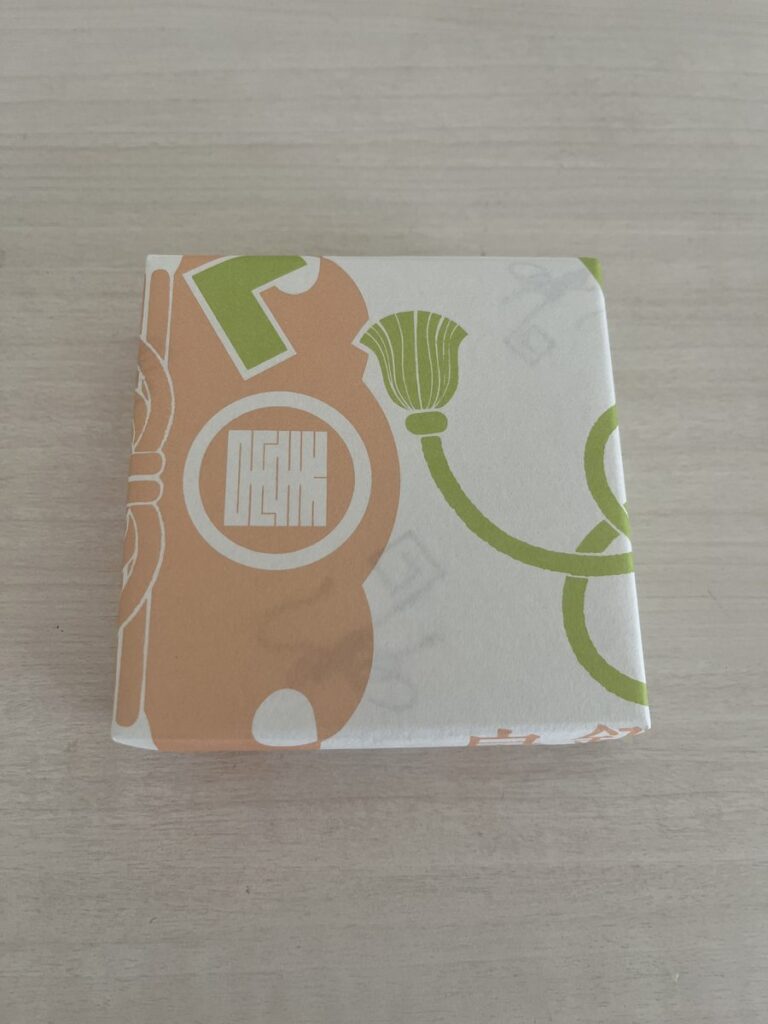
The 6-piece box in Kagizen’s wrapping paper, bought at Meidi-ya in Hiroo, Tokyo.
What kagi-mochi is
Kagi-mochi is a rice cake in its simplest, most careful form. Mochi, the soft and chewy rice cake, runs through Japanese food and celebration. Gyuhi is its more delicate cousin: rice flour cooked slowly with sugar until it turns smooth, tender and slightly stretchy. Habutae-mochi is an especially fine, silky gyuhi, named after habutae, a light and glossy Japanese silk.
Kagizen kneads habutae-mochi and coats each piece in kinako, a pale golden flour of roasted soybeans with a gentle, nutty fragrance.
The dough is made from Japanese rice flour cooked the old way, with sugar and a little egg white. It is worked slowly so that air folds in, which gives it a texture that is soft and almost springy rather than dense. The kinako is generous; there is always some left in the box.
It is also a mochi that keeps its softness for a few days, which is why it has long been a Kyoto gift to carry home.
I have always loved gyuhi, and habutae-mochi in particular. But most habutae-mochi is thin, and after a few pieces I find it a little too sweet. Kagi-mochi is habutae-mochi too, yet it is cut thick enough to feel satisfying, and the kinako keeps the sweetness in check. The soft give of the gyuhi and the kinako meet in just the right balance.
I like it best with a cup of green tea.
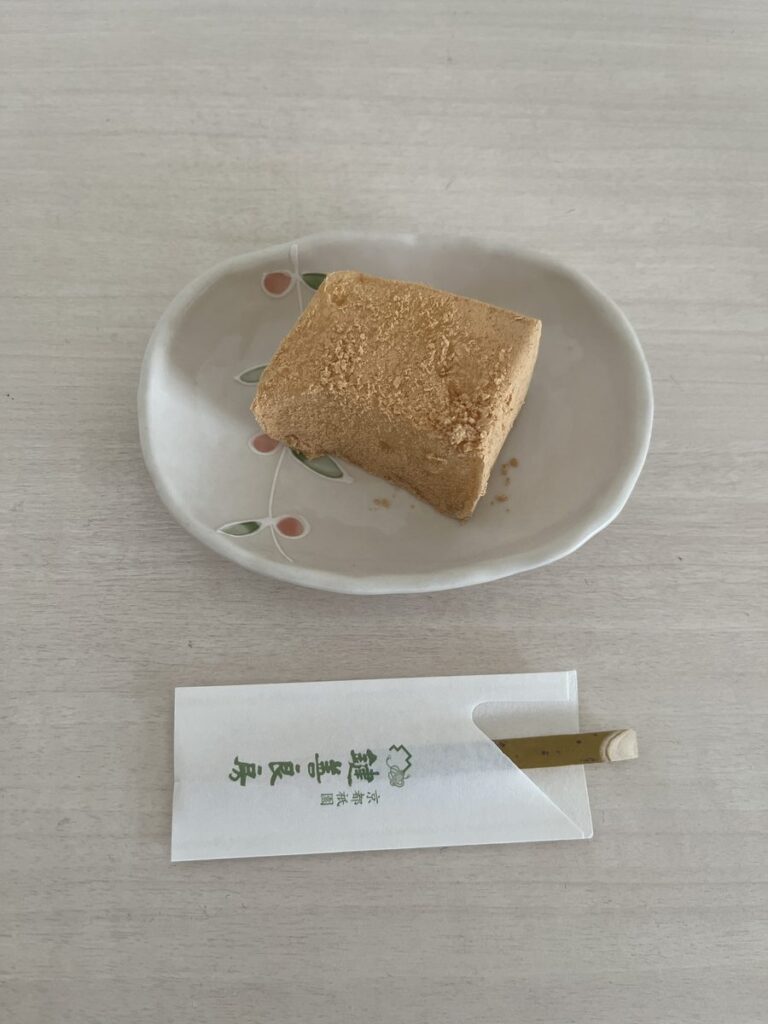
One piece, cut thick enough to feel like a proper treat.
Kagizen Yoshifusa: keeping what is good, trying what is new
Kagizen Yoshifusa was founded in the Kyōhō era (1716–1736), in the middle of the Edo period (1603–1868), when Japan was ruled by the shoguns. Old documents found in its storehouse suggest it may be even older. The shop moved to its present spot on Shijō-dōri, Gion’s main street, in the Meiji era (1868–1912), when the street was widened.
Gion grew up as the town in front of Yasaka Shrine, and later as Kyoto’s best-known hanamachi, or “flower town”: a district where geiko (Kyoto’s geisha) and apprentice maiko entertain guests at teahouses. Kagizen made sweets for that world — for teahouses, theatres, writers and artists with demanding palates.
What makes Kagizen worth writing about is not only its age. Each head of the house has kept the old sweets as they were, while quietly trying something new.
A shelf by an unknown craftsman. In 1931 the twelfth head, Zenzō Imanishi, asked Tatsuaki Kuroda, a young woodworker from Gion who was still unknown, to build the great display shelf in the shop. Zenzō was close to the mingei movement, which found beauty in plain, handmade everyday objects, and bought work from young artists to support them. Kuroda went on to make furnishings and even mother-of-pearl vessels for the shop’s kuzukiri. In 1970 he became the first Living National Treasure for woodwork — the popular name for the title Japan gives to masters who carry an important traditional craft.
A tearoom for kuzukiri. Kuzukiri — clear noodles made from kuzu, a fine Japanese arrowroot starch, served chilled and dipped in kuromitsu, a dark brown-sugar syrup — is younger than it looks. After the war the shop reopened in 1955 and began serving it, first as an after-meal dessert. It was later served in a long, narrow room where apprentices had once lived. By the 1970s, people across Japan linked kuzukiri with Kagizen, and it is still eaten only in the shop.
A gallery for young artists. The previous head, Tomoo Imanishi, opened a small gallery space, Sora Kagiya, where young artists could show their work.
A café and a museum. The current, fifteenth head, Zenya Imanishi, trained with a confectioner in Tokyo before taking over in 2008. In 2012 he opened ZEN CAFE and a gift shop in a stone-paved lane in Gion, with sweets served only there. In 2021 he opened ZENBI, a small museum on the same lane, to archive and pass on the culture his predecessors had gathered. Its first exhibition was the shop’s own Kuroda collection.
He is as willing to stop as to start. He once halted production of a signature box of higashi — small dry sweets pressed from rice flour and sugar in carved wooden moulds — rather than let its flavour slip. In 2024 he also published a book recording the shop’s handwork in detail, because, as he put it, no one knows how long such work can continue.
Kagi-mochi sits quietly in the middle of all this: the same simple sweet, made the old way, from a house that keeps finding new ways to share it.
A sweet for special days
Kagi-mochi does not need a season. It suits a birthday, a visit from someone dear, or a quiet afternoon you have decided to make your own.
This year, my special day is the New Year. In Japan, mochi has always belonged to the first days of the year. Families set out kagami-mochi, two stacked rounds of rice cake, as an offering, and eat mochi in zōni, a soup served on New Year’s morning. So a box from Kyoto fits in naturally. But the real reason I am sending it home is simpler: I want my parents and family to taste it, be as surprised as I was, and enjoy it.
The larger boxes also suit a gift. The 12-, 20- and 25-piece boxes normally come wrapped in noshi: a sheet of gift paper printed with red-and-white mizuhiki cords, folded around the box. In Japan, noshi marks a present as a celebratory or formal gift; Kagizen’s is plain, with no written inscription. The 25-piece box comes in a wooden case.
Even the 6-piece box, which comes without noshi, is packed with care: an illustrated card and a wooden pick in a Kagizen paper sleeve.
If you are sending a box at New Year and want Kyoto’s classic seasonal sweet too, Kagizen also makes hanabira-mochi (“petal mochi”), Kyoto’s traditional New Year sweet, sold for the season only: sweet white-miso bean paste and a strip of candied burdock root folded inside a thin round of soft mochi.
How to get it
You can buy kagi-mochi at the main shop in Gion or order it from Kagizen’s online shop for delivery within Japan. Shipping is extra.
Kagi-mochi sometimes turns up outside Kyoto, too. I had heard that Meidi-ya, the long-established grocer in Hiroo, Tokyo, receives it only on Mondays. So I went on a Monday and came home with the 6-piece box in these photos. If you try the same, check with the store first.
| Box | Price (tax incl.) | Wrapping |
|---|---|---|
| 6 pieces | ¥1,400 | Gift-wrapped, no noshi |
| 12 pieces | ¥2,500 | Red-and-white noshi |
| 20 pieces | Check the shop | Red-and-white noshi |
| 25 pieces | Check the shop | Wooden box, noshi |
Prices as listed by Kagizen and Orange Page; they can change.
A few things to know before you order, especially for the New Year:
- It is fresh. Kagi-mochi is best within five days, counting the day it ships. Choose a delivery date close to when it will be eaten.
- Order early. Kagizen usually opens New Year orders in early December. Last year, the final delivery date before New Year was 29 December.
- The 6-piece box pauses over the holidays. Last season it was not sold from mid-December until mid-January. For a New Year gift, plan on 12 pieces or more.
- Far regions take longer. Hokkaido, Aomori, Akita, Iwate and some islands need two days from Kyoto.
If you are visiting Kyoto from abroad, the shop is the simplest option. Buy it near the end of your trip so it is still soft when you share it.
Visiting the shop
| Shop | Kagizen Yoshifusa, Shijō main shop |
| Address | 264 Gionmachi Kitagawa, Higashiyama-ku, Kyoto |
| Hours | Shop 9:30–18:00; tearoom 10:00–18:00 (last order 17:30) |
| Closed | Mondays (the next day if Monday is a holiday) |
| Access | 3 minutes’ walk from Gion-Shijō Station (Keihan line) |
| Online shop | shop.kagizen.co.jp |
Hours from Rurubu. Holiday hours differ around New Year, so check before you go.
If you are in Kyoto, try the kuzukiri. I have not had it myself yet — kagi-mochi is the sweet I know — but kuzukiri is what most people come to Kagizen for, and it can only be eaten here. It is made from carefully chosen Yoshino kuzu, a prized arrowroot starch from the Yoshino area of Nara, and served chilled with chips of ice in a lacquered box, with black sugar syrup for dipping (white syrup is also offered). Have it in the tearoom, then pick up a box of kagi-mochi at the counter on your way out.
The tearoom can have a queue, especially on weekends. Kagi-mochi to take away is sold at the counter, so you can still buy it if you have no time to sit down.
Further reading: Gion Kagizen Kashigatari
If the box leaves you curious, Zenya Imanishi, the fifteenth head of Kagizen, has written a book about the house and its sweets: Gion Kagizen Kashigatari (祇園 鍵善 菓子がたり), “Tales of Sweets from Kagizen, Gion.”
It is a beautiful book in its own right. Printed in full colour, it reads less like a shop history and more like a book about art. It follows wagashi, traditional Japanese confections, through the twelve months of the year. Page by page, it shows how deeply Japanese people love the four seasons, and how confectioners turn the beauty of each season into a small sweet meant to be eaten at just that time. It also looks closely at their colours, shapes and the carved wooden moulds used to make them. Sadly, the text is only in Japanese. But if you can make out just the seasons in Japanese, I think it is a book you can fully enjoy with your eyes alone. The photographs speak to anyone who loves Japanese craft.
- Author: Zenya Imanishi (今西善也)
- Publisher: Sekai Bunka Books / Sekai Bunka Sha, December 2021
- 191 pages, ¥3,500, ISBN 978-4-418-21324-5

FURTHER READING
Gion Kagizen Kashigatari
祇園 鍵善 菓子がたり — Tales of Sweets from Kagizen, Gion
by Zenya Imanishi, fifteenth head of Kagizen Yoshifusa
A full-colour book that follows Kyoto’s wagashi through the twelve months, showing how each season’s beauty becomes a small sweet. It reads like a book about art. The text is in Japanese only, but it is a pleasure simply to look through.
Sekai Bunka Sha, 2021 · 191 pages · ¥3,850 (tax incl., as of 20 Nov 2026) · Japanese
View on Amazon JapanView on Rakuten BooksThis card contains affiliate links. As an Amazon Associate and a Rakuten affiliate, I earn from qualifying purchases.